



Industry Views

SABO SEZ: Learn the Habits of Power and Success

By Walter Sabo
a.k.a. Walter Sterling, Host
WPHT, Philadelphia, “Walter Sterling Every Damn Night”
TMN syndicated, “Sterling on Sunday”

imgAs a media consultant, my team has had the privilege of being engaged extensively by members of the C-Suite. Becoming a member of the C-Suite is a common goal. To get into any group, acceptance often depends on acting and appearing like established members. Here are some of the actions observed of business masters whom we consulted:

Arrive First

Let’s start with Walter Anderson, CEO PARADE magazine. PARADE was then owned by Newhouse and was the most-read publication in the English language with 30-million-plus readers. Walter Anderson was a rock star. For years he was an award-winning editor and proud of his publication. He was a gifted leader. Smart writers and graphic designers want to work for Anderson. He’s that guy! It was an honor to have lunch with him… always at the Four Seasons.

Lunch at 12:30 pm. I’d arrive at 12:25 pm – Anderson was well seated. Lunch at 12:30, I’d arrive at 12:15 pm and Anderson was well seated. I had to arrive at 11:30 am to “beat” him to the 12:30 pm table. When I finally arrived at 11:30, he was startled that I arrived first. Score! I shared this story with the manager of the Four Seasons, Julian Niccolini. Julian smiled and said, “The most powerful person always arrives first.”

Arriving first is control, preemptive and, yes, powerful. Arrive first in all actions. The first one in a room can rearrange the chairs and name plates. Arriving first for a meeting gives a person a moral upper hand!

Answer Emails Fast

Our clients have included a long list of CEOs, presidents, and CBOs. Who answers their emails first? The most powerful: Bob Pittman, CEO, iHeartMedia; Julie Talbott, president, Premiere Networks; Kelli Turner, CEO, Audacy; Bob McAllan, CEO, Press Broadcasting; Joe Clayton (deceased), CEO Sirius; Scott Greenstein, president, SiriusXM; Kraig Kitchin, CEO, Soundmind; Tim McCarthy, CEO, Broadcasters Foundation; Alan Shaw, CEO, Centennial Broadcasting; and Chris Oliviero, CBO, Audacy all answer their email super fast. (There are other contacts who answer fast, but this is the CEO/president list.) Most of the other CEOs and presidents who answer late or not at all are bankrupt.

Thank You First

Powerful people send thank you notes – fast. After an event, they send thank you to the host before going to bed. Powerful execs study when people in their industry get an award or promotion and then write notes of congratulations – and stamp it. No emails. Those real letters are saved – forever. Thank you, Cathy Black!

 Know Thy Numbers

Powerful executives are never vague about numbers. Vagueness invites suspicion and erodes confidence. BUT, the powerful are not driven by the numbers. The numbers are not front and center in conversations.

RKO chairman Tom O’Neil hired my company to consult all of their radio stations. Tom was charming, in charge, and larger than life. RKO owned Frontier Airlines. Over lunch, he casually mentioned the passenger load on Frontier that day. He knew those numbers and the ratings for WOR midday. Pass the bread.

Once a year, PARADE and all Newhouse pubs presented their business plans to the Newhouse brothers directly. Participating in that meeting, I saw that the Newhouses expected the CEOs to know their numbers. The CEOs of their pubs presented the numbers. No CFOs, no accountants, and no business managers were allowed in the business plan meetings. CEO direct to owner.

C-Suite members show up first, answer emails fast, know their numbers cold and send thank you notes.

Walter Sabo has been a C-Suite action partner for companies such as SiriusXM, Hearst, Press Broadcasting, Gannett, RKO General and many other leading media outlets. His company HITVIEWS, in 2007, was the first to identify and monetize video influencers.. His nightly show “Walter Sterling Every Damn Night” is heard on WPHT, Philadelphia. His syndicated show, “Sterling On Sunday,” from Talk Media Network, airs 10:00 pm-1:00 am ET, and is now in its 10th year of success. He can be reached by email at sabowalter@gmail.com.
Industry Views

ENOUGH! The Selling Culture Has Failed Radio

By Walter Sabo
Consultant, Sabo Media
A.K.A. Walter Sterling
Radio Host, Sterling On Sunday
Talk Media Network

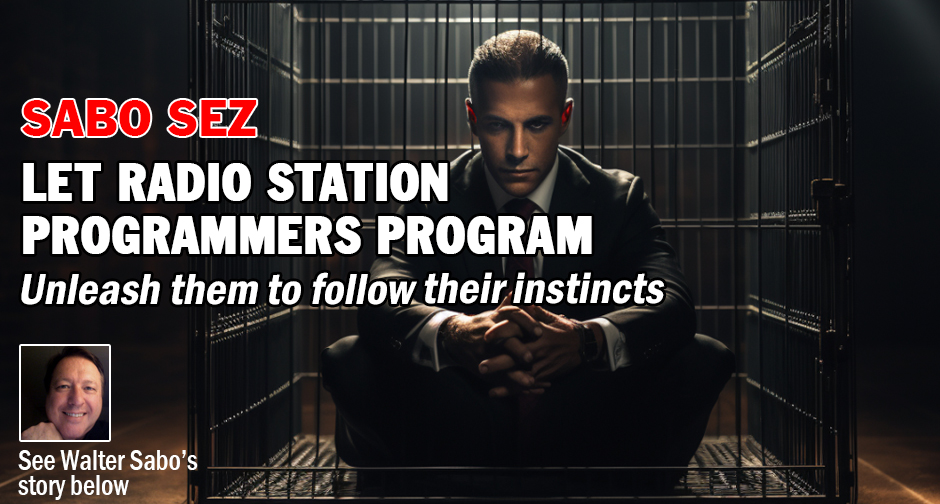
The creeping culture of sales-determines-all has brought the industry to this moment of despair. The selling culture has failed the medium. It is time to, once again, segregate the sales and programming departments. Take the budgets away from the program directors and inspire them to create exciting UNPREDICTABLE programming.

Earnings calls for most radio companies were held this week. Not pretty. Declarations of the demise of radio are constant, emotional, and desperate. Bleak conditions in the radio industry have occurred before. A review of past crises and how they were overcome is constructive, urgent, and essential.

For example, in 1952, network TV was launched and showed signs of success. NBCABC, and CBS moved their money from radio to TV. Longform radio shows were cancelled leaving stations across the country with a problem. At the time, most radio stations were small shops, usually family-owned, therefore the need to add hours of local programming was a financial challenge. The solution was presented by a programmer.

Todd Storz’ family owned stations in Omaha, Kansas City, Minneapolis, New Orleans, St Louis and Oklahoma City. He was young and obsessed with radio. His stations were losing money and the future, without network show blocks, was uncertain. Todd ate at a diner daily and noticed that even after it closed, the waitresses put their own money in the jukebox to hear the same songs they had heard all day. Hit after hit. Todd created a list of the top 40 songs, built a production sound and put it on his Omaha station. The station was #1 overnight. His top 40 format was aired on his owned stations with the same results.

Ruth Meyer was the program director of WMCA, New York where she established the GOOD GUYS dynasty. Before WMCA Ruth was the PD of Storz’s station in Kansas City. I asked her who did what at Storz and she said, “It was all Todd.” Todd was a programmer who never spent a day in sales. Storz’s programming idea changed and, yes, saved the industry.

When Todd died at 38 years of age his father – a businessman – took over the company. After Todd’s death, the stations died too. Why? Storz station manager Deane Johnson explained, “Todd’s death [and the control of the radio stations falling to Todd’s father] brought about a shift from a ‘programming company’ to a ‘money company.’”

Radio’s next challenge was FM. It is a popular myth that the shift from AM listening to FM was driven by the higher quality of the FM signal. FM’s signal had been available since 1948. No one listened.

You don’t go to iMAX to watch the huge, superior white screen. You go to watch a movie on the huge superior white screen. When the FCC mandated an end to AM/FM simulcasts, the general managers had no idea what to do and isn’t it time for golf?

Obsessed, very young radio fanboy programmers such as Michael Harrison and Allen Shaw joined with frustrated senior programmers like B. Mitchel ReedScott MuniMurray the K and Tom Donahue to EXPERIMENT with new programming techniques. They imagined and implemented progressive rock, free-form, album rock. THEN the crowds came to FM to hear exciting UNPREDICTABLE programming.

In 1966, Tom O’Neil, the founder/chairman of RKO General owned many money-losing, major market stations. The solution? Better sellers? Better sales training? A sales master course? No. The answer was Bill Drake. O’Neil hired Bill Drake and allowed him to create exciting UNPREDICABLE programming. Drake’s programming saved many RKO stations and was copied by hundreds of stations across the country. Drake’s programming saved them, too.

ALL of radio’s challenges today can be solved with programming invented by programmers free to program. Enough with “it’s not in the budget.” Enough with “it will bring in money.” Enough with “it’s good for sales.” Enough with talent having to generate half their salary in billing to be retained. Enough!

Unleash today’s program directors to follow their instincts, their facts and no more having to check with corporate. Why? Because checking with corporate hasn’t worked. Checking with corporate stops the flow of ideas, it freezes them in time. Radio is live, in the moment. When radio programming is frozen in time it MUST failGive up corporate engagement. Let programmers surprise you.

To quote a mentor, ABC Radio Network’s VP Dick McCauley (a sales guy), “A great salesperson is one who has a great product.” He said it a lot.

Walter Sabo was the youngest executive vice president in the history of NBC. He was the programming consultant to RKO General longer than Bill Drake. According to a Sirius corporate EVP, “Sirius exists because of what Walter Sabo did.”  He hosts a Talk Media Network radio show as Walter M. Sterling, “Sterling on Sunday.” Find out more here: www.waltersterlingshow.com  Contact him at walter@sabomedia.com or 646.678.1110