


Industry News

TALKERS Books Drops “Speeches They Never Gave,” Richard Chemel’s Collection of 50 Imagined Addresses by Historic Figures to Modern Audiences

Veteran music promoter, new-media pioneer and former TALKERS Pop Culture Editor is available for interviews on AI, authorship and what old voices can tell a modern newsroom

TALKERS Books has published Speeches They Never Gave: Volume One, a collection of 50 imagined speeches compiled and created by Richard Chemel. The paperback went on sale at Amazon on November 7.img
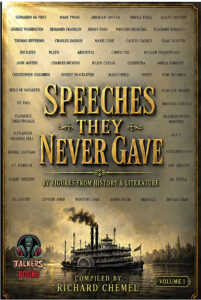
imgThe premise is simple but fascinating. Chemel takes a figure from history or literature, hands that person a present-day subject, and stands them in front of a specific modern audience. For example, Mark Twain talks to journalists about social media. Abraham Lincoln addresses newsroom editors on political polarization. Socrates takes on the internet and misinformation for a room of high-school students. Dracula explains fear and public relations to media executives, and P.T. Barnum has a few things to tell advertising executives about their own business.

Several of those rooms are full of people who work in this industry, and that is by design. Chemel spent his career in and around broadcasting. In the 1970s, he worked in radio promotion on behalf of musical artists including Heart, ELO, and Bob Seger. He moved into special-interest video marketing with Jane Fonda’s home-fitness series, Shirley MacLaine’s Inner Workout and WrestleMania. He was the first host of the Los Angeles Times online platform, moderated chats for MSN Money on CNBC, and served as pop culture editor of TALKERS magazine. The book began with a question he typed into a search engine: what would Al Capp have to say about the world today? The answer suggested a larger project, and each of the 50 pairings that followed started the same way – as a question Chemel wanted to hear answered.

In his author’s note, Chemel writes that broadcasting taught him that “the right voice, saying the right thing to the right room,” can move people further than almost anything else. He was a 20-year-old student at Kent State in May 1970, and he traces his conviction that listening matters back to that month.

A plain statement about AI

Chemel used AI tools in drafting the speeches and says so in the book, in a section titled, “How This Book Was Made.” He describes prompting, rejecting, rewriting and revising, and he is specific about what the tools did not do: choose the premise, the speakers, the audiences or the argument of any speech. “Tools change,” he writes. “Someone still has to have the idea, make the choices, and put a name on the result.”

That disclosure makes him a timely guest. Questions he can take on the air include:

  • When a host, writer or producer uses AI, what does the audience have a right to know?
  • Who is the author when a machine helps with the sentences?
  • Is it fair to put new words in the mouth of Lincoln or Jefferson, and where is the line between interpretation and fabrication?
  • Why does a 19th-century voice sometimes say something about social media that a contemporary one can’t?

The speeches are works of creative interpretation. None was actually delivered by the person or character depicted.

TALKERS publisher Michael Harrison states, “We are very proud to add this timely book to our growing catalogue of talk media-friendly works by authors who make great conversational guests.”

For each paperback sold on Amazon, a donation goes to the Fisher Center for Alzheimer’s Research Foundation. This is an independent promotion; Amazon is not a sponsor.

Availability: Speeches They Never Gave: Volume One is available now at Amazon. More information is at hellospeeches.com.

To book Richard Chemel for an interview, or for signed and bulk orders:hellospeeches@gmail.com
Industry Views

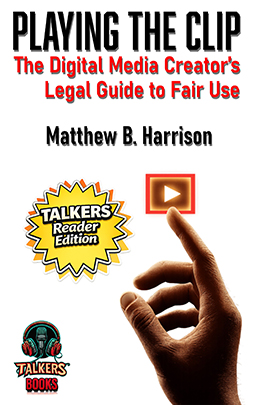
TALKERS Books Announces Publication of Playing the Clip: The Digital Media Creator’s Legal Guide to Fair Use

TALKERS Books announces the release of, Playing the Clip: The Digital Media Creator’s Legal Guide to Fair Use, by media attorney (and imgTALKERS magazine associate publisher) Matthew B. Harrison, a work designed for today’s news/talk media environment where audio, video, screenshots, and quotes are not just supporting elements – but serve as the actual content itself. This technique has become particularly prevalent on YouTube and even cable news/talk TV but increasingly appears in audio form as what used to be called “actualities” – sound from another source.

The book introduces and defines what TALKERS identifies as the “Play the Clip” technique: the now-standard practice across broadcasting, podcasting, streaming, and social platforms of presenting the source material rather than merely describing it. Although this practice has become ubiquitous, it leaves content creators and providers vulnerable to legal ambiguity, uncertainty, and consequences.

At a time when creators increasingly rely on third-party media to inform, critique, and engage audiences, Playing the Clip addresses a persistent gap between how content is created and how the law evaluates it. Theimg book explains the legal concept of fair use not as a permission structure, but as a legal defense raised after copying has already occurred – an uncomfortable but essential distinction that underpins the entire analysis.
Rather than offering abstract theory or checklist-style guidance, the book focuses on how courts actually evaluate real-world uses. It examines the operational realities creators face: platform incentives, inconsistent enforcement, monetization pressures, and the false sense of security created by what “everyone else is doing.”

The central premise is straightforward: infringement is the starting point, not the conclusion- and fair use, when it applies, is the justification that must be built from there.

Playing the Clip is now available:

  • Print Edition (Amazon): $24.95
  • Kindle Edition (Amazon): Limited-time promotional price of $1.00

Free to TALKERS subscribers

In addition, TALKERS is making the book available at no cost to its readership for a limited time.

Below is a form just for TALKERS readers. Just submit your email address to receive access to a free digital copy, available in either EPUB or PDF format, depending on preference. This offer is intended to ensure that working media creators -regardless of platform or budget – can access the material during its initial release window. To receive a free book, please click here.

Industry Views

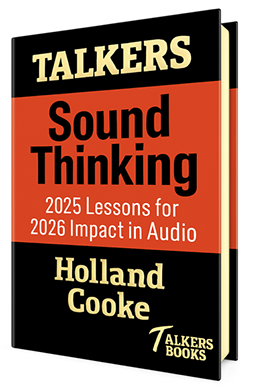
Monday Memo: Sound Thinking

By Holland Cooke
Consultant

Each week here, TALKERS affords me a voice in the career conversation we all share. Iimg appreciate this real estate, and your feedback.

To say thanks, publisher Michael Harrison and I have a stocking stuffer for you, an anthology of all 2025 “Monday Memo” columns. Included: additional pieces I filed on Tuesdays of holiday weeks when TALKERS didn’t publish on Mondays; and daily reports during the Consumer Electronics Show and NAB Show, both of which I have covered for this publication for decades; and additional reports on news and trends pertinent to you, my fellow storyteller.

Here ya go, an instant E-book download: http://getonthenet.com/SoundThinking.pdf

And here’s to 2026!

Holland Cooke (HollandCooke.com) is a consultant working the intersection of broadcasting and the Internet. Follow HC on Twitter @HollandCooke and connect on LinkedIn

Industry News

TALKERS News Notes

Talkers Books, the book publishing arm of TALKERS, celebrates the first anniversary of the release of one of its most successful titles, From Immigrant to Public Intellectual: An American Story (Talkersim Books, 2022) by Dr. Murray Sabrin. The book has been an Amazon bestseller and a popular vehicle sparking conversations on political news/talk shows across America. Its author, Murray Sabrin, Ph.D. is emeritus professor of finance, Ramapo College of NJ. Dr. Sabrin – a prolific author – is considered a “public intellectual” for writing essays about the economy in scholarly and popular publications as well as being a prolific guest and “go-to” resource on hundreds of radio and TV talk shows and podcasts. According to publisher Michael Harrison, who wrote the book’s provocative foreword, “From Immigrant to Public Intellectual is a truly American story about an immigrant child’s rise from humble beginnings to forge a stellar career as an educator, author, candidate, and media influencer. Murray Sabrin explains libertarianism in plain language using his own life story set against a half-century of changing times. Talk show hosts have been tapping into this articulate scholar’s knowledge and views for more than three decades since his impressive third-party showing as the Libertarian candidate for Governor of New Jersey in 1997.” To learn more about Dr. Murray Sabrin please visit murraysabrin.com and murraysabrin.substack.com.

SiriusXM’s Megyn Kelly will host a special live edition of her program on December 6 at 10:15 pm ET immediately following the “NewsNation” Republican Primary Debate. SiriusXM’s Triumph channel will also carry the debate live.

New York-based software firm Aiir Inc announces the addition of five news staffers. They include Paul Carlin and Phil Ray who join the customer support team in the UK. Phil Hannon joins Aiir’s team in North America, as does Chase Daniels, who has been serving as Bold Gold Media’s director of programming. Additionally, Alex Watson assumes the newly created position of customer experience specialist.

Edison Research’s Top 10 Findings of 2023 will be unveiled in a 30-minute webinar on December 13 at 2:00 pm ET. Edison says the list-worthy findings on audio, podcasts, radio, exit polls and more from its custom research and syndicated datasets will be presented by many of the researchers who worked on the studies.

Industry Views

Monday Memo: Be Known for Knowing

By Holland Cooke
Consultant

“STIMULATING TALK.”  Like much of radio’s imaging wallpaper, this frayed 1990s promo cliché was station-centric, rather than a benefit statement explaining and assuring how habitual use is… useful.

“Stimulating” was an immeasurable claim. And won’t THEY be the judge of that? If our talkers – of any political stripe – are stimulating, their work speaks for itself.

“Talk” itself has baggage. Say “talk radio” at a backyard cookout populated by non-radio people, and someone will roll their eyes. Rush Limbaugh personified that “crazy uncle at Thanksgiving” who became the format caricature.

imAnd when what’s-talked-about sounds too much like yesterday, and the day before, and the day before that, it works against what ratings people call horizontal maintenance (same-time day-to-day tune-in). No names, but his first six words when I tuned in were “…and it will only get worse!” Stimulating?

Commercial Copy 101: Sell benefits, not features. Almost any station can sound instantly more-user-friendly by simply projecting “you” and “your” early and often in promo copy. “Because ONE traffic jam can jam-up your WHOLE day…”

News will save news/talk. Mass shootings du jour, deadly severe weather, inflation, Trump, Hunter’s laptop, and what-next has listeners wondering, “What NEXT?” Be known for knowing, and you will stimulate more tune-ins.

Holland Cooke (HollandCooke.com) is a consultant working at the intersection of broadcasting and the Internet. He is the author of “Spot-On: Commercial Copy Points That Earned The Benjamins,” a FREE download; and the E-book and FREE on-air radio features “Inflation Hacks: Save Those Benjamins;“and Multiply Your Podcast Subscribers, Without Buying Clicks,” available from Talkers books. Follow HC on Twitter @HollandCooke