

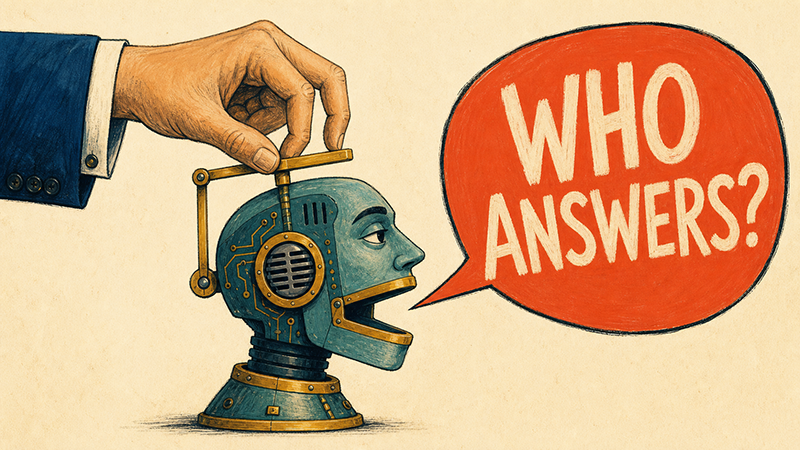
When AI Speaks, Who’s Accountable?
By Matthew B. Harrison
TALKERS, VP/Associate Publisher
Harrison Legal Group, Senior Partner
Goodphone Communications, Executive Producer
 New laws may hold AI companies responsible, but regulating machine-generated speech presents risks of its own.
Florida recently sued OpenAI and CEO Sam Altman, alleging that they marketed ChatGPT while concealing known safety risks. California has taken a different approach: a company accused of causing harm cannot defend itself simply by saying the AI acted autonomously. Neither development guarantees liability, but both signal that “the AI did it” may no longer work as a legal escape hatch.
That sounds sensible. An AI model cannot pay damages, carry insurance, exercise professional judgment, or go to jail. If a company releases a system, profits from it, and markets it as useful or reliable, the law should at least ask what the company knew, promised, and reasonably could have prevented.
Mark Walters – host of Armed America Radio – learned how difficult that can be. ChatGPT falsely reported that he had been accused of embezzling money from a gun-rights organization. Walters sued OpenAI for defamation, but a Georgia court granted the company summary judgment in 2025, finding insufficient evidence that OpenAI knew the output was probably false. The machine was wrong; the legal remedy failed.
The harder question involves speech. Colorado adopted requirements intended to prevent discriminatory automated decisions, prompting AI to sue on First Amendment and equal-protection grounds. The Federal Trade Commission has now suggested that secretly steering a model away from the accurate or objective answers users expect could itself constitute consumer deception.
This presents a genuine slippery slope. Government should protect people from fraud, defamation, discrimination, dangerous products, and nonconsensual deepfakes. It should not acquire a broad power to decide what an AI system must identify as “truth,” particularly in areas involving politics, history, public policy, or contested scientific opinion.
For broadcasters and content creators, the immediate lesson remains familiar. AI may assist with research, writing, editing, and production, but it does not inherit responsibility for the finished product. The person or company that publishes the words still needs to verify them, while the companies building the machines should not escape scrutiny merely because no human typed the final sentence.
Accountability should follow control, knowledge, and profit. The challenge will be imposing that accountability without turning AI regulation into government supervision of lawful speech.
Matthew B. Harrison is a media and intellectual property attorney who advises radio hosts, content creators, and creative entrepreneurs. He has written extensively on fair use, AI law, and the future of digital rights. Reach him at Matthew@HarrisonLegalGroup.com or read more at TALKERS.com.