

Carr: FCC to Address Public Safety
Federal Communications Commission chairman Brendan Carr, in a blog post, says the FCC is beginning to address public safety as part of its Build America Agenda. He says, “In three weeks, we will vote to begin a ground-up re-examination of the Emergency Alert Systems (EAS). EAS sends life-saving information using TV and radio outlets, and our Wireless Emergency Alerts (WEA) distribute the emergency notices we receive on our mobile phones. With underlying frameworks that are 31 and 13 years old respectively, we think it’s time to explore if structural changes to these systems are needed, with an eye towards making sure we are leveraging the latest technology to save lives. Similarly, we will also vote to initiate a review of our system for collecting real-time data on network outages and restoration during and after major disasters. Since its inception in 2007, our Disaster Information Reporting System (DIRS) has proven to be a valuable tool for collecting actionable information to help with recovery efforts. While the DIRS reports are valuable, they can be time-consuming to produce, drawing resources away from responding to an ongoing disaster. The Commission will vote on reforms to streamline DIRS to make sure that its benefits outweigh its burdens. We’ll close our August meeting by removing unnecessary regulations and injecting common sense across the Commission’s policies—critical features to streamline the implementation of our Build America Agenda.” See the full blog post here.
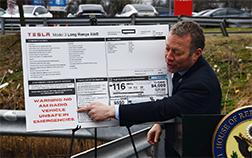 served as the sole lifeline during times of crisis like 9/11, Hurricane Sandy, and other major storms and floods,” Gottheimer has sent a letter to the National Highway Traffic Safety Administration, urging them to require auto manufacturers that exclude AM radio reception from their motor vehicles to display a safety warning in the car’s window sticker that should read: “Warning: No AM Radio. Vehicle Unsafe in Certain Emergencies.” Gottheimer is also a supporter of the AM Radio for Every Vehicle Act that would require auto manufacturers to keep AM radio in vehicles, without charging customers extra for it. Gottheimer says, “Buying a car without AM radio is like buying a car without an emergency parking brake. You may not use it every day, but you’ll be glad you have it if your brakes ever go out.”
 the report as momentum grows in Congress for legislation to ensure AM radio is accessible to the public in all vehicles. NAB president and CEO Curtis LeGeyt states, “When disaster strikes, AM radio has proven time and again its invaluable role as a source of factual, authoritative, up-to-the-minute information that saves lives. It is also a home to a diversity of programming that is often unavailable on other mediums and particularly important to otherwise underserved communities. It is critical that Congress address the need for AM radio capability in vehicles to ensure Americans can turn to local AM stations when they need them the most.”