


Monday Memo: “What Matters Next” for Radio?
By Holland Cooke
Consultant
 If you work in radio, you’ve heard every flavor of AI anxiety. Some fear it will wipe out jobs. Others treat it like a super shortcut – cranking-out spots, promos, and proposals faster and cheaper. Kate O’Neill’s What Matters Next lands squarely in the middle of this tension, and its message is one radio people need to hear: AI isn’t the disruptor. Human behavior is. AI just accelerates the consequences.
The book’s central argument is blunt: The organizations that thrive in an AI-driven world are the ones that stay relentlessly human. Not sentimental – human. Curious. Adaptive. Willing to rethink habits that calcified long before the first smart speaker ever said, “Now playing.” That’s a mirror radio hasn’t always wanted to look into.
For decades, the industry has survived by optimizing the familiar: tighter clocks, leaner staffs, syndicated shows, templated production, and “good enough” digital. AI tempts some operators to double down on that instinct – to automate more, localize less, and hope listeners won’t notice. This book argues the opposite: AI punishes sameness and rewards originality. When every business has access to the same tools, the differentiator becomes the people who use them with imagination, empathy, and purpose. That should sound familiar. It’s what radio used to brag about.
O’Neill also warns against the other extreme, the fear-driven paralysis that keeps talented people from experimenting. AI isn’t a job eater; it’s a task eater. It clears the underbrush so humans can do the work only humans can do: judgment, storytelling, connection, and community presence. In radio terms: the stuff listeners actually remember.
Imagine a morning show that uses AI not to replace prep, but to deepen it, surfacing hyperlocal stories, analyzing listener sentiment, or generating alternate angles on a topic the hosts want to explore. Or a sales team that uses AI to tailor proposals to each client’s issues instead of reshuffling the same deck. How about a newsroom (remember them?) that uses AI to sift data so stations can spend more time delivering what’s special to listeners (and sponsors): helpful local news they can’t get anywhere else. None of that eliminates jobs. It elevates them.
This book’s most important warning is this: AI widens the gap between organizations that learn and organizations that cling. Radio has lived through this before – streaming, podcasting, social media, smart speakers. The winners weren’t the ones who panicked or the ones who ignored the shift. They were the ones who adapted early, experimented often, and stayed close to their audience.
Holland Cooke (HollandCooke.com) is a consultant working the intersection of broadcasting and the Internet. Follow HC on Twitter @HollandCooke and connect on LinkedIn
 provides important benchmark measures for usage and behavior around streaming audio, podcasting, radio, smart audio, social media, and debuting this year, never-before-seen data on AI usage. Annual results and trending data from The Infinite Dial are relied upon by its audience of content producers, media companies, agencies, and the financial community.” The webinar will feature Edison vice president of research Megan Lazovick with special guest James Cridland, editor of Podnews.
 TALKERS magazine, the leading trade publication serving America’s professional broadcast talk radio and associated digital communities since 1990, is pleased to participate as the presenting sponsor of the Intercollegiate Broadcasting System (IBS) conference for the second consecutive year. The conference is currently underway in New York.
 radio industry (and its related fields) seeks to connect with and develop a next generation of professional practitioners as well as engaged audiences. TALKERS is honored to again provide financial support, encouragement, experience, and advice to the dedicated organizers of this very special event.
 dashboards and API access that support automated reporting and portfolio-level insights. The collaboration will also support select broadcast attribution initiatives within Audacy’s radio portfolio, complementing existing measurement partners. Audacy president of digital sales Michael Biemolt says, “Audacy consistently strives to deliver measurable results for advertisers, and our partnership with Podscribe further strengthens that promise. With enhanced attribution and transparency across our portfolio, we’re giving clients even greater confidence in how Audacy drives performance at scale.”
 morning radio show with co-hosts DJ Envy, Jess Hilarious and Loren LoRosa. Charlamagne Tha God comments, “When it comes to iHeartMedia, gratitude will always be my attitude. They’ve created space for me to grow not just as talent, but as an executive and true partner through The Black Effect Podcast Network. To say that I’m thankful is an understatement. iHeart is the biggest and best audio company on the planet and audio is the foundation on which the whole media conglomerate will be built. Podcasting, live events, TV/film and documentaries, the sky is the limit for where we are going; and radio will always be at the core of it. Here’s to a new era of growth, impact, and prosperity.”
 The Cumulus Media | Westwood One Audio Active Group unveils an audio planning guide based on data from Edison Research and Nielsen data. Saying that there are incorrect assumptions among strategists and media planners about which audio media have the most listeners, chief insights officer Pierre Bouvard underscores that AM/FM radio is still the dominant ad-supported audio platform with a 66% share. Podcasting is second with a 20% share and this is true across all demographics. For those who are all-in on digital audio only, Bouvard says they are missing 70% of the potential audience as ad-supported Spotify, Pandora and podcasts reach only 30% of the U.S. in a typical day. Further, Bouvard says the data suggests an optimal allocation of audio ad spend: “The ideal allocation for a 25-54 audio plan is 62% AM/FM radio, 24% podcasts, 12% music streaming (Pandora, Spotify, Amazon Music, and YouTube Music), and 2% SiriusXM satellite radio.”
  “Longtimers” and notes that 77% of “First-Years” are consuming podcasts while actually watching the video compared to 69% of “Longtimers” doing the same. Edison says that most new consumers and established podcast fans are actively watching while listening to video podcasts but that video is even more important for engaging with new audiences. While “Longtimers” currently have an affinity for audio only podcasts, that may change over time. Edison concludes that although podcasting is an audio-first platform, “many creators and marketers are likely missing an audience acquisition and engagement opportunity by not considering how to fit video content and video platforms into their strategic planning.”
 In radio and podcasting, editing isn’t just technical – it shapes narratives and influences audiences. Whether trimming dead air, tightening a guest’s comment, or pulling a clip for social media, every cut leaves an impression.
 last 11 years, the study has been reprised annually to track buy-side podcast advertising consideration and intention. The latest Advertiser Perceptions study, conducted in June 2025 with 302 marketers and media agencies, reveals advertiser/agency podcasting usage and interest has reached an 11-year high.” Some of the notable takeaways from this study include: 1) Nine out of 10 marketers and media agencies say they have discussed podcast advertising for potential investment; 2) Podcast advertising consideration surges to an eleven-year high: 74% of brands and agencies say they are likely to consider advertising in podcasts; 3) Podcast spending intention jumps to 69%, an eleven-year record; and 4) 78% of agencies and advertisers currently advertise in podcasts, a 5X increase since the first IAB podcast upfront in 2015.
 Remember how Larry King would interrupt rambling callers to ask, “What’s your question?” It could sound gruff, but it was really a courtesy, to viewers or listeners. Larry feared TV clickers and dashboard radio buttons. He kept-it-moving to keep viewers and listeners from wandering.
 Radio is an intimate, one-to-one medium; so “you” and “your” – speaking to one person – will resonate more than addressing “all of you.” There’s only one of me.
 Francisco. iHM region president AJ Punjabi says, “Alan’s deep experience in both traditional broadcast and digital audio innovation makes him the ideal leader to drive our business forward. His results-driven approach and commitment to client success will strengthen our market leadership across platforms.” Hirschbein comments, “I’m energized to join iHeartMedia’s tremendous leadership team as vice president of sales. As the enduring leader in broadcast radio, iHeartMedia has also transformed itself into a dynamic force in podcasting and digital audio, standing at the forefront of audio innovation. I’m eager to contribute to this continued evolution and help our partners harness the unmatched reach and engagement that only iHeartMedia can deliver.”

 was $22.3 million, up 7% over Q2 of 2023. Audacy also breaks out revenue by radio format categories and while Sports radio revenue was $71.1 million (up 8.3% over last year), News/Talk revenue was $43 million (a decline of 2.3% from the same period a year ago). Audacy chairman, president and CEO David J. Field comments, “Audacy continued to deliver strong 2024 financial performance with Q2 Adjusted EBITDA more than doubling, up 116% vs. prior year. For the first six months of 2024, Adjusted EBITDA is up 128%. Our accelerating financial performance reflects our significant revenue share gains, low-teen growth in digital advertising, high single-digit growth in network radio, and prudent expense reductions, offsetting continued weakness in traditional ad markets. Notably, our transformational, strategic investments are emerging as a critical driver in our accelerating performance. Recent improvements in our streaming and podcasting platforms, along with further enhancements to our digital monetization and programmatic capabilities are increasing their impact on our top-line and bottom-line results. As previously announced, we received court approval of our consensual pre-packaged Plan of Reorganization in February and are awaiting FCC approval to complete the process. We continue to expect final approval and emergence to occur during the current quarter. The third quarter is currently pacing up low-single digits, and we expect another quarter of significant Adjusted EBITDA growth.”
 43% of spoken word listening, and podcasts 36%. Keep in mind that for Edison’s purposes spoken word content includes news, sports talk and play-by-play, audiobooks, talk shows, and “personalities.” Edison states, “Podcasting’s share of spoken word will almost surely surpass that of AM/FM within a few more years. There is one more thing to note – the advantage for AM/FM is coming entirely from those age 65 and older. Among those ages 13-64, podcasting has already passed AM/FM listening by, 41% to 39%. Meanwhile, among the oldest Americans age 65+, AM/FM radio continues to dominate, with a 66%-13% advantage. Curiously, that 66%-13% difference among the oldest Americans is the exact same difference we recorded for all Americans 13+ in 2017.”
 Because you can? Because you aren’t doing AM/FM radio? Because you are on radio, but can’t-do-there what you can-do podcasting? Because you are making money podcasting?

 proceedings in the United States Bankruptcy Court for the Southern District of Texas and has filed a proposed Plan of Reorganization that incorporates the terms of the RSA and is subject to approval by the Court. Under the terms of the RSA, a supermajority of debtholders committed to vote in favor of the Plan, which, when approved, will reduce Audacy’s funded debt from approximately $1.9 billion to approximately $350 million. Audacy’s debtholders will receive equity in reorganized Audacy. Audacy expects that the Court will hold a hearing to consider the approval of the Plan in February and to emerge from bankruptcy once regulatory approval is obtained from the Federal Communications Commission. Audacy has filed with the Court a series of customary “First Day Motions” to obtain Court authority for the Company to continue operating its business in the ordinary course without disruption to its advertisers, vendors, partners or employees. Audacy expects to operate normally during this restructuring process under its current leadership team.
 AudioPack has 20 pieces of audio available to download including SFX and musicbeds. It includes party ambiance, sunny musicbeds, Labor Day listener drops, glass clinking, beer-drinking, BBQ sizzlin’, pool splashing SFX.
  iHeartMedia’s financial by segment, broadcast radio revenue was $429 million, a decline of 7.2% over Q2 of 2022. Network radio was $122 million (down 4.2%), digital revenue (excluding podcast) was $164 million (down 1.6%), and podcasting revenue was $96.7 million (up 12.9%). iHeartMedia chairman and CEO Bob Pittman says, “We are pleased to report that our second quarter 2023 results reflected Adjusted EBITDA slightly above the midpoint of the guidance range, and more than double the Adjusted EBITDA we generated in the first quarter, and our consolidated revenue were above the guidance range. The continued positive performance of our Digital Audio Group, led by our Podcasting business, and the significantly improved relative performance of our Multiplatform Group during this soft advertising period, are encouraging metrics for us, and we’re seeing indications of improving macroeconomic trends which we expect to have a positive impact for us in the second half of the year, with most of that impact in Q4.”
 the journal refers to AM, FM, online and satellite talk radio, cable news/talk TV, and talk podcasting.
 Springfield, MA, joined TALKERS as its managing editor almost a quarter-of-a-century ago in 2000. The big story during that pre-9/11 year was the excruciatingly inconclusive presidential election between Texas Governor George W. Bush and Vice President Al Gore that took over a month to settle.
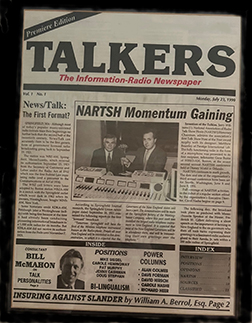 format phases including a full color magazine and eventually a daily online operation geared to providing news, advice and opinions to professionals involved in programming, managing, marketing and operating an array of related platforms in what has come to be known as talk media. This includes most popular forms of spoken-word AM and FM radio, plus online programming, podcasting, cable television and satellite broadcasting. During this period, TALKERS has produced and presented 26 national conventions in New York and another three in Los Angeles. Add to that more than 35 regional, national and international forums about the field and countless radio rows including several at the White House in conjunction with both the Bill Clinton and George W. Bush administrations. TALKERS remains and will continue to be a non-partisan proponent of the First Amendment with a great love and passion for talk media’s roots in the century old medium of radio.
 on his long-running “Urban View” channel program on Sirius XM Satellite Radio. The two legendary radio figures took a deep-dive into the subjects of podcasting, AM radios in cars, the role of boomers in today’s culture and the way in which the annual TALKERS Heavy Hundred list is compiled. Don’t miss this conversation!
  streaming, podcasting, and wagertainment properties. Under Davis’ leadership, the team will be responsible for sales and execution, managing the entire client lifecycle.” Audacy chief revenue officer Brian Benedik comments, “No medium delivers more value for sports than audio. People are spending more time than ever with broadcast radio, streaming and podcasts, and the demand for compelling sports content across these channels is growing exponentially. Through our best-in-
 class sports audio portfolio, powered by over 150 flagship team partnerships, iconic local broadcast brands, award-winning podcasts and sports betting content, Audacy is uniquely positioned to capitalize on a new sales strategy in this arena.” Audacy says, “From 1990 to 2005, Davis was key in building WFAN into America’s #1 sports radio station, overseeing local and national sales, programming and marketing, helping shape it into the highest-grossing station in the country.” Davis rejoined Audacy in 2018 to lead the reboot of Traffic Weather Information Network’s on-air content and ad operations teams.
  PricewaterhouseCoopers LLP, “quantifies annual podcast advertising revenues generated over the past year, analyzes revenue share by ad category and content genre, and forecasts future revenues through 2025.” The study says the top revenue-generating content genres are Sports (15%), Society & Culture (14%), and Comedy (14%) and have taken the lead from News and Political Opinion content (down from 19% to 12%). IAB VP, media center Eric John says, “In-person sports, lifestyle events, and in-store shopping have come back in a big way, taking the lead from news which held the top revenue genre spot since 2018. Podcasting revenue naturally reflects that shift in consumer behavior and it will be interesting to watch how the balance changes going forward.” He adds, “Both mass and niche advertisers like the audiences, targeting, and ROI along with the brand-safe and suitable environments that podcasting offers.”
  company posts a Q1 2023 net loss of $35.9 million, an increase of 225% compared to Q1 of 2022. Audacy chairman, president and CEO David J. Field states, “First quarter revenues were down 5.7% with local sales significantly outperforming national as challenging ad market conditions persisted. Cash operating expenses were up 3% during the quarter but are expected to be below prior-year levels for the remainder of 2023. Notwithstanding the difficult economic headwinds, we remain steadfastly focused on delivering significantly higher future levels of Adjusted EBITDA, capitalizing on our multiple growth drivers and our differentiated premium competitive position in the dynamic audio market. We are making progress on each of our drivers, including our podcasting and digital marketing solutions businesses, our reinvented streaming audio platform, our emerging ad tech and ad products, and our enhanced national enterprise business development efforts. In addition, we are encouraged to see some positive signs in our auto business as we continue our vigorous work to weather the storm and await future improvements in market conditions.”
 order): Heather Cohen, SVP, The Weiss Agency; Steve Goldstein, CEO, Amplifi Media; Ron Hartenbaum, managing partner, WYD Media; Chris Oliviero, market president, Audacy New York; David Pakman, talk show host/commentator, The David Pakman Show; and Larry Young, talk show host, The Larry Young Podcast.
 planners). Suchman writes that this argument “is among the ultimate tussles between media planners and publishers. While some may lean more heavily toward video, we at Audacy respectfully disagree.” He makes a five-point argument in audio’s favor saying it wins in reach, time spent using, is more immersive, activates all senses, and drives recall.