

iHeartMedia Announces AudioGraph to Deliver Attribution to Broadcast Radio
iHeartMedia unveils AudioGraph – a suite of advertising capabilities that the company says will, for the first time, “bring digital-like targeting, identity-based planning and measurement, and outcome-based attribution to broadcast radio at scale.” These capabilities are powered by Triton Digital, the global technology and services leader. iHeartMedia says, “The vast majority of audio  consumption (64%) comes from broadcast radio, yet up until today, it has lacked the targeting and measurement infrastructure available in digital. iHeartMedia’s broadcast radio stations reach more than 278 million consumers every month, and now with AudioGraph, for the first time, advertisers can plan, target, measure, and attribute that audience using privacy-safe, ID-informed insights with digital-like precision.”
Powered by Triton Digital, AudioGraph makes it possible by connecting a privacy-safe identity spine, enriched audience attributes built from TransUnion data, and proprietary ID-level listening models that enable planning and measurement at the listener level while activating campaigns at broadcast scale. Proof of concept shows that broadcast radio campaigns planned and measured using privacy-safe AudioGraph IDs can deliver a KPI outcome 75% higher than traditional demo-based plans.
iHeartMedia chief business officer Lisa Coffey comments, “Audio has always delivered unmatched scale and human-to-human connection, but measurement and precision have lagged behind digital. With nine out of 10 Americans listening to broadcast radio every month, it’s extremely important that buyers can access this scale and impact with the precision and efficiency of digital media. With AudioGraph, we’ve closed that gap. Marketers can now use audio as an addressable and measurable performance channel at a national scale; with the same accountability they expect from every other part of their media plan.”
 high since 2022 and 28% indicate they commute some days; 2) 85% of average Americans are commuting to work, slightly less than marketers and media agencies (92%); 3) Since AM/FM radio is the “soundtrack of the American worker,” it is the ideal media platform for advertisers; 4) AM/FM radio’s share of ad-supported audio in the car has been consistently dominant at an 83% share, according to Edison Research’s Q1 2026 “Share of Ear” report; 5) Average Americans are clocking slightly more days at work (4.7) compared to the advertising industry (4.4); and 5) Marketers/agencies and average Americans are most likely to work in the office Monday through Thursday with Friday seeing the lowest % of in-office work for both groups.
  understate the immense sales effect power of creative. Some 122 marketers placed creative as the third most important contributor toward driving sales behind targeting and brand. But the reality based on analysis of 450 ad campaigns indicates creative is far and away the most important driver of sales. Both marketers and agencies place the greatest importance on targeting. Experts caution that too narrow targeting is ineffective.
  exploring the audio strategies behind real business success to provide behind-the-scenes insights, creative inspiration, and tips from brands that are scaling with sound. Topics being addressed include: 1) What makes audio such an effective channel for performance and brand-building. 2) How local advertisers are using radio to stand out and win more wallet share. 3) Why podcast hosts have become some of the most trusted voices in advertising. And 4) Lessons learned: real-world advice from brands turning listeners into loyal customers.
  marketers about perceived media effectiveness in which radio came in last place, behind all measured traditional and digital media types. According to Nielsen’s global ROI benchmarks, radio delivers the second highest return for advertisers, second only to social media. Nielsen’s ROI benchmarks show radio delivers higher returns for advertisers than all other other traditional media. While radio is perceived to be less effective than digital media, it delivers an ROI +30% higher than video and display, and +70% higher than search and CTV.
  study of 303 media agencies and marketers conducted in August 2024 found the perceived combined audience share of Pandora/Spotify is 43%, much greater than the perceived share of AM/FM radio (27%). In reality, “According to the Q1 2025 Share of Ear, AM/FM radio’s persons 18+ share of ad-supported audio (68%) is 14 times larger than ad-supported Pandora (5%) and ad-supported Spotify (5%).” The data also reveals that podcasts take the second-place spot with a 20% share. Ad-supported Pandora (5%), ad-supported Spotify (5%), and ad-supported SiriusXM (3%) lag distantly.
  ABX AM/FM radio creative study for RAB proves legendary marketing professor Mark Ritson was right; 2) Wear-out of AM/FM radio ads is virtually non-existent: Only two of 25,000 ads showed a decline in some creative effectiveness metrics. Two major creative effectiveness measures, branding and messaging, showed no wear-out; 3) The two ads showing differences were at the top end of cumulative spending and time in market: Two years in market and $8M+ of spend is where creativeness effectiveness might start to wane; 4) Repeat testing of 10 of the 12 longest running AM/FM radio ads reveals no statistically significant erosion; and 5) The giants of marketing effectiveness and creative testing conclude wear-out is non-existent: Take it from Les Binet/Sarah Carter, ABX, Kantar, System1, and Analytic Partners.
  Interestingly, marketers and media agencies massively underestimate the immense sales effect power of creative. NCSolutions says that creative drives half of sales, about two-and-a-half times what advertisers perceive. The Advertiser Perceptions February 2024 study reports brands and media agencies say creative only represents 19% of total sales effect. NCSolutions science reveals creative generates an eye-popping 49% of incremental sales. According to System1 chief customer officer Jon Evans, “Creative is the number one factor in explaining the performance of your advertising and yet most marketers still don’t realize it. That means that those who focus on getting the creative right have a huge competitive advantage. Firstly, marketers need to wake up to the importance of creative and secondly realize it isn’t some dark art but something you can measure and improve to give you an advantage over the competition who haven’t realized this yet.”
  March is half over, and the Madness is just beginning.
 Survey says nearly half of all Americans over 13, nearly 135 million, listen to spoken word formats. The growth curve boasts an eye opening 52% jump in time spent listening at home.
 -platform audio with media plans that utilize radio, digital audio and podcasts, working together to reach audiences with unprecedented precision and drive quantifiable outcomes for their brands.” Some of the findings within the guide include: 1) Audio advertising works harder – driving more than two times the attention of TV and social media at more desirable CPMs; 2) Radio and digital audio are stronger together. A multi-platform audio strategy is so powerful that advertisers see 1.5 times the return on ad spend compared to digital-only campaigns; 3) Advertisers are leaving upwards of $6 billion in revenue on the table by not including total audio – a balanced mix of traditional broadcast radio and digital audio – in their media mix, according to a study conducted by Audacy and Neustar. The report also offers actionable tips for producing effective ads under the section titled, “5 Ways the Best Audio Ads Crush the Status Quo.” Here, Audacy says, “Advertising on the #1 reach media — Audio — will get you the most ears. But to keep them, your creative can’t just be good — it needs to be really freaking great.”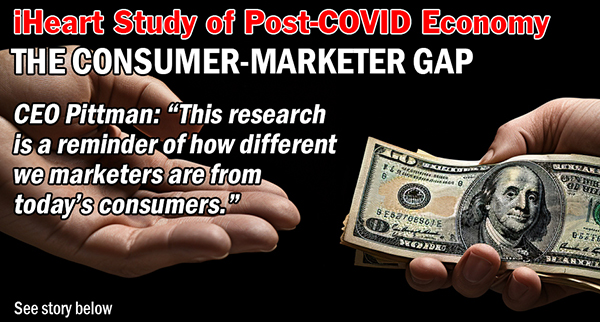
 underestimate time spent with AM/FM radio. While they believe Americans spend 9% of their media time with AM/FM radio, the reality is 15%.” Why is this? The report cites two reasons. First, longtime ad agency executive Bob Hoffman says, “How can professional people who work in an industry that is largely constructed on media behavior be so astoundingly misinformed? The answer is pretty simple… marketers always overestimate the attraction of new things and underestimate the power of traditional consumer behavior.” Second, marketing professor Mark Ritson adds, “There is increasing global evidence that marketers are basing their media choices on their own behavior or that stoked by the digitally obsessed marketing media, rather than actual audience data.”
  Until NASA approves company logos on rockets, the fastest billboards an advertiser can buy move at over 200 miles per hour, weigh less than seven ounces and are three-hundredths of an inch thick.
 and streaming for everything from brand awareness to consumer purchase. Audacy chief marketing officer Paul Suchman says, “Audio holds the title as the undisputed leader of brand-building channels – working its magic with the one-two punch of massive reach and beloved and trusted personalities. But if you’re thinking of Audio as just a top-of-funnel play – good for sparking a conversation but not driving conversion – think again. The truth is the game has expanded in recent years and audio is now a truly multi-purpose platform. Thanks to precision targeting, authentic influencers whose listeners follow them across channels, and advanced measurement, marketers are uncovering the best-kept secret in media – audio’s ability to drive impact at every funnel stage.”
  ‘Stuff You Missed in History Class’ podcast, Holly Frey; and esteemed journalist, author and co-founder of Pushkin Industries, Malcolm Gladwell, joined with today’s biggest marketers to explain why podcasting is growing rapidly and how brands need to adapt, invest and create audio advertising that resonates with podcast fans.” iHeartMedia Digital Audio Group CEO Conal Byrne says, “Podcasters are the most creative, fastest-growing, diverse wave of influencers to hit content and marketing in years – just as influencer marketing more generally was becoming a key new way to reach audiences. This event came together because our podcast creators are deeply invested in the brands and advertising that become part of their shows, that they asked us to give them a chance to sit down with marketers at scale and talk about what makes host-read creative work. What really differentiates podcasting and our iHeartPodcast Network from other mediums is that creators and fans expect the advertising to be endemic to the shows, often voiced by the hosts and authentic to the listening experience. This is a chance to roll up our sleeves and co-create, collaborate and showcase the simplicity, speed and creative potential of podcasting.”