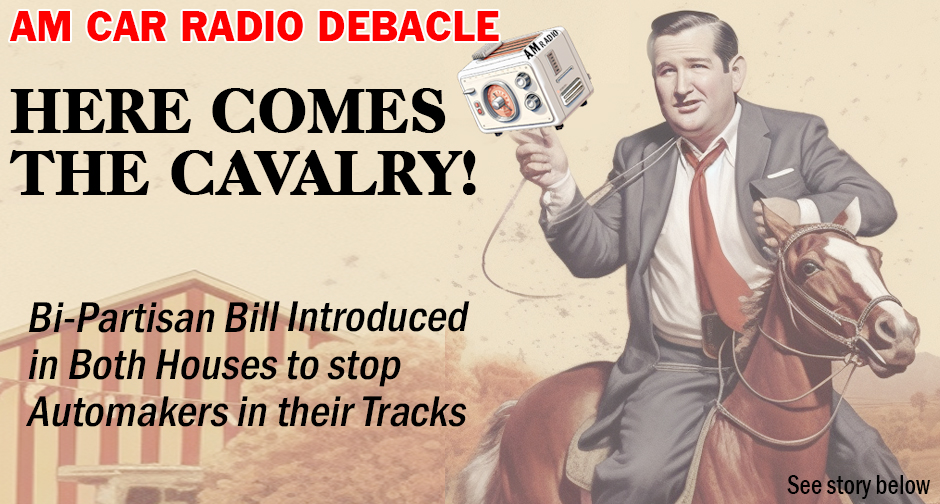


TALKERS Exclusive: Why AM Radio Still Matters – And Why Cities Must Step Up to Save It
By Frank Morano
City Councilor
New York City 51st District
Staten Island
 For most of my life, the sound of an AM signal has been my constant companion. Long before I ever spoke into a microphone professionally, I was the kid hiding under the covers with a transistor radio, slowly turning the dial, discovering voices, ideas, communities, and worlds far beyond my bedroom. AM radio didn’t just shape my career – it shaped who I am.
That’s why, as both a lifelong AM radio listener and a longtime AM broadcaster (77WABC and WNYM-AM “970 The Answer”), I’m introducing legislation in the New York City Council to require that all City-owned and City-contracted vehicles continue to include functioning AM receivers. I’m proud of my work in government, but this one is personal. Because AM radio isn’t just entertainment or nostalgia – it’s infrastructure. It’s public safety. It’s the backbone of our emergency communications system. And it’s in danger.
When Everything Else Fails, AM Radio Doesn’t
We don’t have to imagine what happens when modern communications collapse. We’ve lived it.
On September 11, 2001, when cell networks jammed almost immediately, millions of New Yorkers turned to AM radio for news, instructions, and reassurance.
In the 2003 Northeast Blackout, AM signals were among the very few communications systems still functioning across multiple states.
During Superstorm Sandy, when much of the region lost power and internet for days, AM remained a critical lifeline for emergency updates, evacuation information, and weather alerts.
These weren’t theoretical scenarios. They were real moments of crisis – and AM radio proved its value every single time.
When the lights go out, AM stays on. When cell networks are overwhelmed, AM cuts through. When the internet fails, AM continues broadcasting. It is the most resilient form of mass communication ever created, and FEMA and the National Weather Service still rely on AM frequencies for a reason: they reach people when nothing else can.
AM Radio Is Still the Soundtrack of America
Beyond emergencies, AM radio remains woven into the cultural fabric of this country. It’s where Americans talk to each other – about politics, sports, faith, overnight oddities, neighborhood issues, and everything in between. It’s one of the last places where anyone can call in, join the conversation, and be part of a community.
The same AM dial that once carried the voices announcing D-Day, the moon landing, and the gritty street reporting of New York legends still carries the news, opinions, and debates that shape American life today. There is something uniquely democratic about the AM band: it is accessible, unpretentious, inexpensive, and available to everyone.
That’s worth preserving. Especially now, as some automakers – particularly in the electric vehicle space – phase AM radios out of new models, citing interference or cost concerns.
Cities and States Can Lead Where Washington Waits
Congress is considering the “AM Radio for Every Vehicle Act,” and I support it wholeheartedly. But federal action can take time. Cities and states can move faster.
New York City’s legislation can be a model:
- If municipalities require AM receivers in the vehicles they procure…
- If state governments do the same for their fleets…
- And if enough jurisdictions stand firm…
Automakers will have no choice but to keep AM radio in every vehicle they sell.
Government can’t – and shouldn’t – tell anyone what to listen to. But we absolutely can ensure that the option to listen still exists. And that, when disaster strikes, the public can rely on a system proven over nearly a century to work under the toughest circumstances imaginable.
The Signal Must Go On
AM radio isn’t a relic. It’s a lifeline. It’s a civic space. It’s one of the last great mediums that belongs to the people. As someone who owes much of his career – and much of his identity – to those airwaves, I feel a responsibility to protect them.
By acting locally here in New York City, I hope we inspire communities across the country to do the same. If we want the AM dial to be there for the next blackout, the next storm, or the next unthinkable moment, the time to act is now.
Because when everything else goes silent, AM radio still speaks.
And we need to make sure it always will.
Frank Morano was recently elected City Councilor representing New York City’s 51st district. Prior to that he forged a distinguished career in talk radio at WABC and WNYM in New York. Councilor Morano can be reached via email at frank@moranoforcouncil.com.
 National Association of Broadcasters. She said, “AM Radio is important to communities across the country not only because it is a cultural, news and sports oasis that educates the public, but also because it is a resilient lifeline during public safety emergencies. To put it as simply as I can, the foremost reason that Congress should care about AM radio is that it is a lifesaver. No other communications medium has the reach or resiliency of AM radio. A single station can be heard as far as 700 miles away. The signal cuts through buildings and mountains. In remote areas where no cell signal or FM station can be found, AM
  is there. When the power goes out, radio stations can still be found on battery or crank radios, or in your car.” She argued that cell phone notifications alone in emergency situations are unreliable as power outages can affect cell service.