


Industry News

Gomez Urges NAB to Push Back on “Election Year Intimidation”

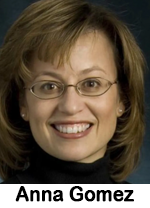
FCC Commissioner Anna M. Gomez is petitioning the National Association of Broadcasters president and CEO Curtis LeGeyt to get behind broadcasters’ concerns about the Commission’s threats to investigate stations for news distortion or broadcast hoax for imgairing polling data “this Administration happens to dislike.” In a letter to LeGeyt, Gomez writes, “This Administration is running a coordinated, government-wide effort to reshape the media into its sanctioned messenger, and the Federal Communications Commission has become one of its most active instruments… The Commission’s own guidance is clear on this point. Enforcement of the news distortion policy requires proof that a broadcaster deliberately distorted a factual report on a significant event, not a minor or incidental one, and courts have recognized that the policy draws a firm line between deliberate distortion and mere inaccuracy or differences of opinion.”
Gomez also pointed to the issue of the equal opportunities rule imgnoting that guidance has been settled on the matter for decades. But she says that acting without input from the full Commission and beyond its authority, the Media Bureau rewrote that settled guidance. “This agency does not get to redefine the public interest standard as whatever happens to serve the political interests of whoever is in power. That standard was written into the law to protect the audiences these stations are licensed to serve, not the officials who regulate them. A broadcaster reporting in good faith, whether covering widely available polling data, booking a candidate based on newsworthiness, or airing political advertising in compliance with the law, should know that it is fulfilling that obligation rather than violating it.”
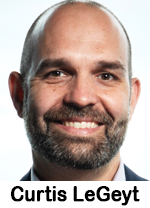
She wraps up by writing: “Despite NAB staying largely quiet through the first year of this censorship and control campaign, I want to acknowledge that you have not stayed completely silent, and for that I am grateful. Your organization spoke up against the FCC’s unprecedented early license renewal order, and I do not take that for granted given the position NAB itself occupies. But I would not be doing my job if I did not say plainly that the volume of that response has not yet matched the scale of what your members are facing. An industry confronting a coordinated effort to turn licensing authority into leverage over election-year coverage needs more than a couple of tempered statements. Your members deserve to hear from their leading voice with the same clarity and urgency that their First Amendment rights, and their bottom line, call for.”  You can read the whole letter here.
Industry Views

Who Gets to Decide If and Why a Guest is Newsworthy?

img

By Matthew B. Harrison
TALKERS, VP/Associate Publisher
Harrison Legal Group, Senior Partner
Goodphone Communications, Executive Producer

imgA political candidate sits down for a broadcast interview. The host asks questions. The conversation reaches into policy, personality, controversy, and campaign issues… just another day in the world of talk radio.

To the FCC, depending on the program and the circumstances, it may raise a different question: did the station give one legally qualified candidate a broadcast “use” of its facilities that now triggers equal opportunities for opponents? That question sits at the center of ABC’s dispute with the FCC over “The View,” and it deserves the attention of every broadcaster who books public officials, candidates, advocates, and political personalities.

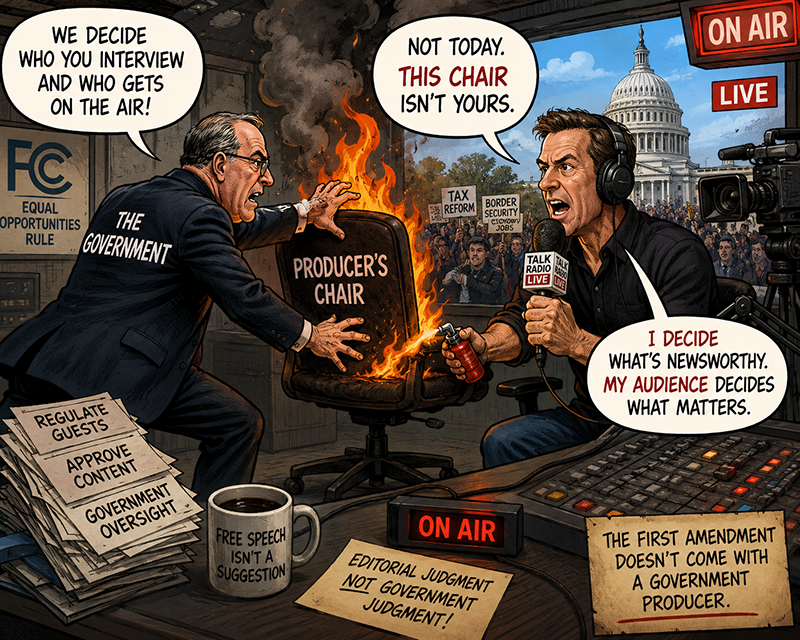
This is not an article about whether anyone likes “The View.” That is the wrong question. The better question is whether the government should decide, after the fact, that a long-running interview program no longer qualifies as a bona fide news interview program because regulators dislike, distrust, or second-guess its guest selection.

The Equal Opportunities Rule, often called “equal time,” is not the Fairness Doctrine. The Fairness Doctrine is gone. However, equal opportunity requirements remain part of broadcast law. In general terms, when a broadcast station permits a legally qualified candidate to “use” its facilities, opposing legally qualified candidates for the same office may be entitled to comparable opportunity, unless an exemption applies.

One such exemption covers bona fide news interviews.

That exemption matters because it allows broadcasters to cover politics without turning every meaningful candidate interview into a scheduling trap. The law recognizes that a news judgment is different from a campaign favor. A host may interview a candidate because that candidate is newsworthy, controversial, powerful, interesting, or central to a public issue, not because the station has endorsed the campaign.

ABC’s argument is that “The View“ already cleared that hurdle more than two decades ago, when the FCC treated it as a bona fide news interview program. ABC now says the Commission has forced the issue back onto the table and is effectively asking whether the government should dictate which candidates the program may feature. That is why ABC’s filing points beyond daytime television and directly toward talk radio.

Talk radio should not dismiss that warning. The format routinely features candidates and officeholders without immediately inviting every opponent. Sometimes the reason is obvious: one guest is in the news and the others are not. Sometimes the reason is practical: a candidate accepts and the opponent declines. Sometimes the reason is editorial: the host believes one interview will better serve the audience.

Those are normal programming judgments. But if regulators start looking behind those judgments for partisan motive, the risk changes. The question becomes less “Was this guest newsworthy?” and more “Can you prove to the government that your reason was acceptable?” That is a dangerous shift for any medium built around editorial discretion.

This does not mean broadcasters should panic or stop booking candidates. It does mean stations, networks and programs should tighten their habits. Know when a guest is a legally qualified candidate. Understand when an appearance may count as a use. Keep clean records. Preserve the editorial reason for the booking. Make sure producers and hosts know the difference between a campaign appearance, a news interview, and paid political time.

The larger warning is simple: broadcast talk is regulated speech in a way podcasts, YouTube shows, and most streaming programs are not. That distinction already matters for indecency, sponsorship identification, public files, political files, and license obligations. Now it may matter again in the heart of the format itself: who gets invited to talk.

The government should not sit in the producer’s chair. But broadcasters should not pretend the chair is invisible. The best protection is not silence. It is disciplined editorial judgment, documented in real time, applied consistently, and defended as what it is: the broadcaster’s constitutional role in deciding what is newsworthy for its audience.

Matthew B. Harrison is a media and intellectual property attorney who advises radio hosts, content creators, and creative entrepreneurs. He has written extensively on fair use, AI law, and the future of digital rights. Reach him at Matthew@HarrisonLegalGroup.com or read more at TALKERS.com.