By Walter Sabo
A.K.A. Walter M Sterling
WPHT, Philadelphia
Sterling Every Damn Night
Sterling on Sunday Syndicated, TMN
Another Side of Midnight, WABC, New York
 In 1952, the success formula for today’s radio was discovered and put into practice by two hungry entrepreneurs: Todd Storz and Gordon McLendon. Both men owned dying radio stations in medium and major markets. The industry was suffering from a lack of purpose or solutions due to the advent of television which drove the migration of hit network radio shows to television. Lucille Ball, Bob Hope, and Gertrude Berg were on radio first.
Storz and McLendon developed “Top 40” with their own brains and money. Top 40 was research and focus group based, as well as. Storz tried it first in Omaha, then Kansas City and Miami. McLendon in Dallas, Houston, Minneapolis, and New Orleans. The formula was simple but not obvious. Their common-sense solution worked in all formats: music and talk.
Ruth Meyer was Storz’s PD in Kansas City and I worked with her at ABC. She was very clear when outlining the Storz history, “It was all Todd.”
Success ingredients
The formula: Target one demographic. Play their hits – often. Call out the names of as many people in the audience as possible – make the listener a star. Present with enthusiasm. Promote at every local crowd event possible. Repeat.
All of the McLendon and Storz stations grew instantly, usually to number one.
That ingredient list works repeatedly for station after station for decades. But, and here’s the but, all of those ingredients have to be in the recipe. Leave out promotion, for example, or research, and it doesn’t work. But the full ingredient list does work for every single format.
I asked Mickey Luckoff, who ran talker KGO as the number one station in San Francisco for most of our lives, how he selected his on air talk hosts to which he replied, “They all come from top 40 because I can teach them talk but I can’t teach them radio.” His promotions were non-stop and smart, TV campaigns were non-stop and research, yes, research – non-stop!
When Adult Contemporary was evolving, my team was responsible for the NBC FM properties. Corporate finance people who went to Wharton urged me to go slow, layer in expenses when launching this odd new format. I knew layering was a recipe – for failure!!! All the ingredients had to be rolled out at once. In 1981, WYNY in New York had a $2 million dollar cash and a $2 million barter promotion budget. Result, a $3 million profit and a 5 share. Thanks to PD Pete Salant and GM Al Brady Law. We used the Storz/McLendon recipe with AC music and Dr. Ruth, it obviously works.
WGMS-FM was a classical station in Washington, DC. When it was owned by RKO and run by visionary Jerry Lyman, it applied the Storz/McLendon recipe to classical music. Their promos announced that WGMS played “Real Oldies – Your favorites from the 1600s, 1700s and 1800s!” WGMS aired a tight playlist of hits. Special weekends were popular, such as a “Beethoven Weekend” with t-shirt giveaways. The station was a profit monster, top 10 in Washington DC.
Five years ago, WABC-AM was about 28th in NYC as a result of cutting costs, by god the cost cutting was epic and so was the failure. Today, John Catsimatidis, the owner, and Chad Lopez, the president, have grown the station to a 4 share and number eight in New York. An AM talk station, number eight and growing. What? How? They put in all the ingredients. The station is data driven. The talent is live. External paid ads run for WABC almost every single day. The air team goes to local events to meet the crowds. WABC airs live listener music requests and dedications on the weekend with Cousin Bruce Morrow and Joe Piscopo – live. Did I mention live?
Today not history
The team is happy. They are making radio. This isn’t nostalgia. Mr. Cats is a very current based businessman who expects results. Like Storz and McLendon he is an entrepreneur, a private owner deploying common sense. He’s doing what is proven, what works. Bravo.
Conclusion: There is nothing wrong with radio. Just stop. Include every ingredient in the proven recipe; expect stunning results.
Walter Sabo has been a C-Suite action partner for companies such as SiriusXM, Hearst, Press Broadcasting, Gannett, RKO General, and many others. His nightly show “Walter Sterling Every Damn Night” is heard on WPHT, Philadelphia. His syndicated show, “Sterling On Sunday,” from Talk Media Network, airs 10:00 pm-1:00 am ET, and is now in its 10th year of success. He recently began hosting “Another Side of Midnight” weekends on WABC, New York. He can be reached by email at sabowalter@gmail.com or phoned at 646-678-1110.



 growth include: SiriusXM’s “Megyn Kelly Show” – up 115% among weekly U.S. consumers 13+; Cumulus Podcast Network’s “Shawn Ryan Show” up 107%; “The Tucker Carlson Show” – up +13%; Premiere Networks’ “Glenn Beck Program – up 11%; and Premiere’s “Sean Hannity Show” – up +5%. Edison says its data indicates Cumulus Podcast Networks’ “Dan Bongino Show” lost the most audience – down 62% – but notes that Bongino’s leave from the business to serve as Deputy Director of the FBI is likely a factor. Elsewhere, podcasts shedding audience include The Daily Wire’s “Ben Shapiro Show” – down 19%; and Cumulus Podcast Network’s “Mark Levin Show” – down 16%. See the full story here.
 As TV is touting its coming attractions, take a step back. We – inside the box – live-and-breathe radio.
 Streaming radio and podcasts don’t just add reach. They double down on impact by warming the audience before they ever click.” The company adds, “Audio brings something no other channel can touch. It’s literally in your audience’s ears. It’s personal. It’s focused. And it shows up during moments where screens aren’t competing for attention, like commuting, working, cooking, unwinding. That’s when messaging sticks. Audio builds familiarity and trust early in the journey, so when someone sees your display ad, social post, or paid search result later, they’re not meeting your brand for the first time. They already recognize you. And recognition drives response.”
  Running a successful radio station, hosting a show, or producing a podcast is a lot like hosting Thanksgiving dinner. You need a plan. You need to deliver something satisfying to a crowd with varying tastes. And most of all – if you get it right – you’ll have leftovers you can turn into even more value long after the main event.
 The drive to stream video of radio shows has always been risky. Remember your shock when you first saw one of your radio heroes? Video streaming can present a constant disconnect between the show in the listener’s head and the show on the stream. Many stations make the disconnect worse by streaming terrible video images. Combine the trauma of how a host really looks with a dreary TV show and the package cannot benefit the relationship between station and listener/viewer.
 right, two shows… one on the radio, one on the stream. Seamless and fun.
 Audio advantage.” The guide provides data to counter prevailing myths that marketers often believe. Some examples include: 1) the notion that “apps have all the audience” is not true as “ad-supported platforms are key to marketer’s winning and Audacy’s 200 million+ is miles above Spotify (48.6M) and Pandora (41.2M)”; 2) “young people don’t listen to audio” isn’t true as 96% of Gen Z listen to audio daily – with 44% being daily radio users; and 3) “I can’t measure audio” is also false because marketers can “track, measure and analyze
  It’s complicated, this whole Federal Trade Commission ruling potentially banning the non-compete. Considering where you stand on the non-compete concept, it’s really all about evaluating the five “C” profile of your media business.
 I’m no expert, but I do have a theory.
 Research shows that readers to trade publications like articles with five bullet points. Here are my five bullet points for 2024. If these were to be deployed, you could be thriving by the end of the year. These actions would increase sales and audience share.
 next best competitor – YouTube Music – at 31%. When it comes to Blacks 35-49, AM/FM reaches 90% of that demographic. The Nielsen report dips into Edison Research’s Share of Ear study and notes that when it comes to share of daily time spent listening to all audio sources (Black adults 18+) 44% of that time is spent with AM/FM radio compared to its next best competitor – streaming audio – with 14%. Not surprisingly, when it comes to the top radio formats listened to by Blacks 18+, rhythmic music stations rank at the top. However, out of the 20 radio formats Nielsen lists in its study, news/talk comes in as the 6th most-listened-to format with a monthly reach of almost 2.4 million. That comes out ahead of sports talk with a monthly reach of almost 1.98 million.
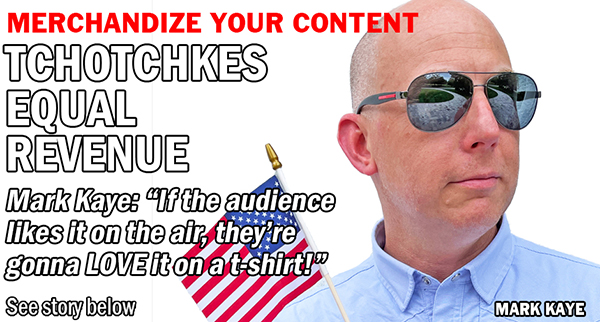
 We have a saying around “The Mark Kaye Show” studio:
 Which is the more important “check the box” trait – persistence or passion?
 Many years ago, I received a late-night call from a legendary radio talk show host who had just been let go by management at the iconic major market station where he had been presiding over the airwaves for several decades. His ratings had begun to downtrend a bit, but he still was a big draw for audience and advertisers. He was one of the biggest names in talk radio history and his still-sizable audience loved him. Thus, the unexpected news of his severance blindsided him with a wallop and surprised the heck out of the biz. Everyone was buzzing about it.
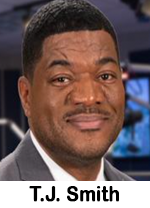 unsolved cases. He later served as press secretary for Baltimore County executive John Olszewski and ran for mayor of Baltimore in 2020. He takes over the midday show after Kimberly Klacik exited the position following seven months on the job. WBAL director of programming Jeff Wade says, “The WBAL audience has known and respected T.J. for years for his frank and honest dialogue on the issues that matter most to people living and working in Baltimore. Whether it’s policing, politics, or talking
  Orioles and Ravens, we can’t think of anyone better suited to sit behind the WBAL microphone weekdays from 10:00 am to 2:00 pm.” Smith comments, “As a native Baltimorean who has gone to school, worked, run for office and even suffered loss in the city, I’m very familiar with the feel of the public from west Baltimore to the waterfront. I couldn’t be more excited to join the WBAL Radio family. I look forward to delivering straight talk and sharing my opinion based on my experience working in government and in law enforcement. I’m ready to ‘tell it like it is’ in a reasonable manner.”
 pandemic. His expertise in national and global affairs was immediately recognized and appreciated by the WBT audience, but it was his fair analysis of the day’s news and his whole-hearted support of the Charlotte community in those difficult times that allowed him to become a welcomed part of the lives of the audience.” Winterble comments, “From the moment I walked into the legendary WBT Radio it felt like home. I am so
  thankful for the welcome and support I received from our clients, listeners, and incredible staff over these past three years. I am truly honored to continue this relationship with the best creators in the business. I am particularly grateful for the support of Urban One/Radio One, and Marsha Landess, Alfred Liggins, David Kantor, Mike Schaefer, and Kraig Kitchin in helping me to realize this professional dream. I can’t wait to see what the future holds for all of us.”
 The embarrassing situation and accompanying financial vulnerability being faced by our colleagues at FOX News is a high-profile example of the consequences of audience “targeting” that has become the common positioning strategy in today’s competitive media marketplace. The process is simple: You give the specifically targeted audience what it wants, not necessarily what it needs, even if what it wants is of dubious quality or unhealthy and – in the case of political talk media – untrue. It is a problematic, unsavory practice that has been brewing in our industry for years and, in the case of FOX, the proverbial toxicity has just hit the fan.
 the 3:00 pm to 6:00 pm slot currently held by Westwood One talk host Mark Levin. Sanchez says, “It is a thrill to be dominating my daypart in the format and I feel my audience growing exponentially right now. It’s a pleasure serving the Las Vegas market with the legendary station KDWN as my flagship.”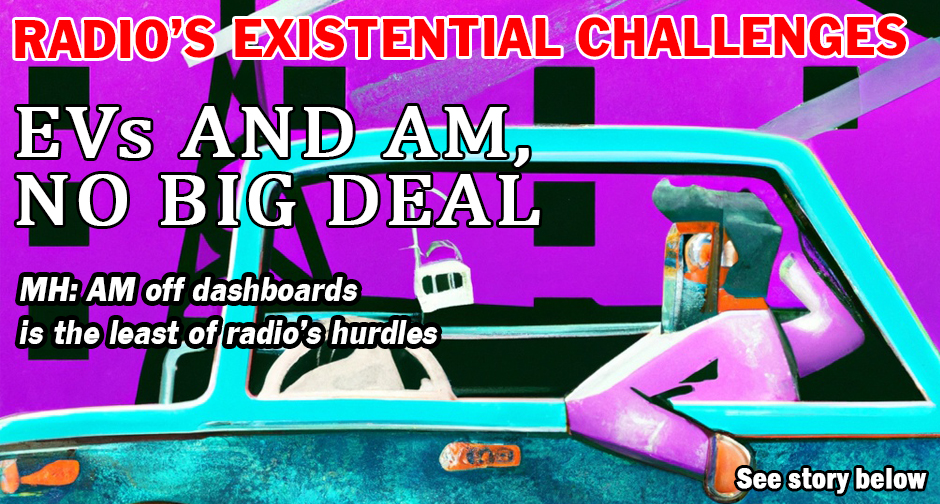
 piece’s “background” information and premises. In the article, Harrison supports the observation that the sale of EVs constitutes a small fraction of the current automotive marketplace and it will be years before they achieve a critical mass to impact the health of AM radio. In the meantime, Harrison asserted at this morning’s meeting of the TALKERS editorial board, “There are far more immediate existential threats to AM radio, not to mention FM radio, with which the broadcasting industry must contend.” He points out, “Relevance and identity! AM radio being dumped from dashboards is an innocuous thing to worry about. FM radio will be dumped from the dashboard as well… the entire idea of a radio-exclusive appliance is on the verge of obsolescence… and we’re not just talking about electric vehicles – we’re talking about all vehicles! We’re faced with an all-encompassing computer system at the fingertips and voice control of the driver and passengers.” Harrison continues, “In the meantime, today’s media consumers are savvy enough to know how to find their entertainment and information brands via the combination of Bluetooth and smartphone. Thus, the challenge facing both AM and FM radio – two increasingly irrelevant designations – is to maintain the importance, distinguishability and brand of the medium itself – R-A-D-I-O – and not let it get lost in an endless ocean of options available to the potential audience.”
  In last week’s column,

 NFL, and this year’s Super Bowl coverage marks the 50th time that the network will broadcast the game. Some of the key takeaways from this study are: 1) NFL postseason AM/FM radio listeners are a desirable group of consumers: They are more likely to work full time and have higher disposable incomes compared to NFL postseason TV viewers; 2) The NFL postseason AM/FM radio audience is more engaged with sports: MRI Simmons finds NFL postseason AM/FM radio listeners attend more sporting events, seek out sports information on their phones more often, and play more fantasy sports than NFL postseason TV watchers. The higher levels of engagement translate into greater advertising effectiveness; and 3) NFL postseason AM/FM radio listeners are more likely to make purchases across key consumer categories: Compared to the NFL postseason TV audience, AM/FM radio delivers more consumers who are likely to buy a new or used vehicle, start a new business, or hire a financial advisor. You can see the complete report