


SABO SEZ: Keep the Valuables
By Walter Sabo
a.k.a. Walter Sterling, Host
WPHT, Philadelphia, “Walter Sterling Every Damn Night”
TMN syndicated, “Sterling on Sunday”
 Amazon learned that there are high volume sales for specific categories of products. High demand equals high value to the seller. Items such as diapers, printer ink, staplers, batteries, etc. Being brilliant, Amazon created “Amazon Basics.” Same products, white labeled. Amazon doesn’t manufacture batteries; they just slap their logos on what America needs most. That’s why Mr. Bezos has a bigger boat than you.
Radio listeners have high demand for basic elements. The demand for these ingredients is often based on need rather than preference. Needed ingredients delivered by radio represent high value to the radio industry:
– Weather reports
– Traffic reports
– Is everything ok? News reports
– News bulletins
– Local news
– Closings
The first sign of trouble was when radio stations chose to promote a cable channel by presenting “Weather Channel Weather.” Tip: research shows the most respected source of weather is the National Weather Service and a station can pull that for free, any time. No disrespect to the Weather Channel but, can’t radio do weather? Giving away that position to TV is foolish.
Weather is even more important than one might think. Yes, a listener can get it from multiple online sources, but the listener is listening to the radio. The listener needs the weather NOW, live, local. Failing to do weather forces the listener to leave you. (That’s why, on the local and national “Sterling” show, we have meteorologist, Dr. Dave Eiser and Brad Your Grandma’s weatherman presenting the weather through the program.)
Do a Google trend search. Compare WEATHER, SEX, JESUS, TRUMP. Weather will win.
TRAFFIC. An argument I lost was with a 50kw station that had the traffic image because they had a traffic copter. To save $200,000 they were going to take it down. I said, “Fire me but don’t take down the copter.” They took it down. The reason to do traffic is not 100% to give traffic reports, it is – more importantly – to prove that the station is live, and to prove the station sees everything. Breaking news will compel listeners to check with the station that can report it from the air, live!
There is no reason to stop doing traffic and weather because an all-news station is doing it. Those are essential must-have elements for all listeners regardless of format. If we want to own the dashboard, it is best to present top-of-mind information to drivers. Live!
FOX News seems to present a “Bulletin” every few minutes… FOX NEWS ALERT. A radio station doesn’t have to follow the AP Style Guide to define “bulletin.” You can air a bulletin or an alert whenever you want. Urgent, compelling, turn up the radio. Pulling the listener in with sounders, big intros, all that stuff claims your position as the source of better-know-it information.
WHAT HAS HAPPENED. By stripping a station of the costs of bulletins, weather, traffic, and local news we have made radio less valuable. Those “costs” were/are investments in content valued by listeners. Too many stations have trashed essential ingredients for the sake of a false economy. Radio revenues go down each quarter as stations cut costs each quarter.
Walter Sabo has been a C Suite action partner for companies such as SiriusXM, Hearst, Press Broadcasting, Gannett, RKO General and many other leading media outlets. His company HITVIEWS, in 2007, was the first to identify and monetize video influencers.. His nightly show “Walter Sterling Every Damn Night” is heard on WPHT, Philadelphia. His syndicated show, “Sterling On Sunday,” from Talk Media Network, airs 10:00 pm-1:00 am ET, and is now in its 10th year of success. He can be reached by email at sabowalter@gmail.com.
 In an opinion piece for TALKERS, radio pro Erik Cudd writes, “In such a time as this, because radio is the medium I know best and love most, I write this appeal to those influential in news/talk. My hope is that you will step forward once again as the architects and innovators you have always been and raise a rallying cry for this unique moment. The freedoms and ambitions that make the format so vital also create challenges. By design, it invites sharp opinions, spirited disagreement, and cultural edge. Those qualities are its strengths. But in our current climate, they also carry the risk of drifting into tribalism and rhetoric that can spill over into something more dangerous. This is not an implication that I believe news/talk is responsible for the death of Charlie Kirk. I would like to be crystal clear. What I am saying is that a perfect storm has been gathering for many years, and no one can deny the polarized, charged landscape we now inhabit. And that storm is not radio’s sole responsibility.”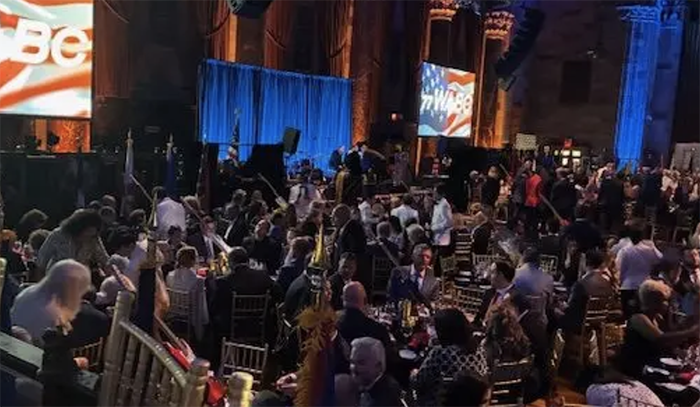
 New York’s Cipriani 42nd Street once again played host to one of radio’s most anticipated annual events of the year: the annual “77 WABC Gala,” held this past Friday (9/5). The spectacular evening blended star-studded entertainment, heartfelt tributes, and plenty of radio family camaraderie – all while raising funds for three cornerstone charities: Tunnel to Towers Foundation, the Police Athletic League, and Shriners Children’s Hospital.
 Superman just flew into court – not against Lex Luthor, but against Midjourney. Warner Bros. Discovery is suing the AI platform, accusing it of stealing the studio’s crown jewels: Superman, Batman, Wonder Woman, Scooby-Doo, Bugs Bunny, and more.
 Hillsdal 101.7 FM – is managed by Scot Bertram, who says, “‘The Radio Free Hillsdale Hour’ is designed to bring listeners as close to the Hillsdale experience as possible without having to be on campus. You can’t get [to Hillsdale] unless you intentionally want to be here. We have many people who like Hillsdale, love Hillsdale, admire Hillsdale. The show is an attempt to allow them to be close to what we’re doing without being here on campus.” Bertram says that Vince Benedetto, president and founder of Bold Gold Media Group, airs the “Radio Free Hillsdale Hour” on two of his 15 stations and says the show gives variety to his stations, which mostly broadcast conservative talk radio focused on current events.
 Beshear will host a new series of live specials, “Andy Beshear Presents,” airing exclusively on SiriusXM Progress. The series will premiere Tuesday, September 9 at 12:00 noon ET. Beshear will be joined by fellow Progress host John Fugelsang and will take calls from listeners across the country. Governor Beshear says. “I want this podcast to be a space to bring people together – especially in such a stressful and divisive time in our country. This is a conversation with friends and we talk about things that matter to all of us: sports, politics, pop culture, our kids. I’m excited to expand this conversation with listeners across the country on SiriusXM, highlighting a wide range of voices and ideas that can help move us all forward, together.”
 significant role in shaping Salem’s growth and direction. Under his leadership, Salem launched and developed four major digital properties: Salem Web Network, Salem Church Products, Townhall Media, and Eagle Financial Publications. Salem CEO David Santrella says, “David has been an important part of Salem’s journey, and we are deeply grateful for his dedication, professionalism, and leadership over the years.” Salem co-founder Ed Atsinger adds, “David’s impact on Salem has been profound. From his early days as CFO to his leadership in building our digital media presence, his contributions have helped define who we are today. We thank him for his many years of service and wish him continued success in the future.”
 in the U.S. House of Representatives and a filibuster-proof 61 in the U.S. Senate. NAB president and CEO Curtis LeGeyt says, “We thank the growing, bipartisan group of lawmakers standing up for their constituents who depend on AM radio. This support demonstrates a deep understanding that AM radio remains an essential lifeline for emergency alerts, local news and community connection. With significant momentum behind this bill, NAB urges House leadership to bring it to the floor without delay and preserve this vital service for the American public.”
 exclude or marginalize competitors like Newsmax. Further, Newsmax alleges that FOX News, “described in the complaint as a ‘must-have’ channel for distributors, leverages its market power to impose restrictions that harm consumers, stifle competition, and drive-up costs across the pay TV ecosystem.” Specifically, Newsmax alleges that “FOX conditions access to FOX News on
  agreements by distributors not to carry or to restrict competing right-leaning news channels. If distributors carry Newsmax, FOX forces them to also carry low-demand channels like FOX Business or FOX Sports 2 in their most widely viewed tiers, triggering potentially tens of millions in extra fees. These clauses penalize distributors for placing Newsmax in basic packages by requiring simultaneous promotion of FOX less popular channels.” Also, Newsmax alleges that FOX has pressured its guests to not appear on Newsmax, as well as has run online smear campaigns and hired private investigators targeting Newsmax executives to damage the Company’s credibility. Newsmax is asking the court to: 1) Declare FOX’s conduct unlawful under federal and state antitrust laws; 2) Award monetary damages as permitted by law; 3) Enjoin FOX from continuing exclusionary contracts and monopolistic practices; and 4) Order equitable relief to restore competition in right-leaning pay TV news.
 Imagine an AI trained on millions of books – and a federal judge saying that’s fair use. That’s exactly what happened this summer in Bartz v. Anthropic, a case now shaping how creators, publishers, and tech giants fight over the limits of copyright.
 host city for FIFA World Cup 2026. “Ready, Set, Grow” happens on September 5 at the Barnes Foundation. Through the end of 2025 and into 2026, WURD will feature on-air programming, live panel discussions, and multimedia storytelling to provide entrepreneurs and neighborhood business corridors with the tools they need to thrive. WURD president and CEO Sara M. Lomax says, “Ready, Set, Grow is crafted specifically for small business owners and entrepreneurs from across the region who are seeking strategies to leverage the historic momentum of America’s 250th anniversary. We are convening a panel of the experts and decision-makers who are best positioned to share how the small business community can make the most of this moment.” Ready, Set Grow’s panel discussion will feature executives from business and tourism organizations.
 WURD, in partnership with Renee Chenault Fattah and Love Now Media, will spotlight 250 iconic Philadelphians in the 250 days leading up to July 4, 2026. The series begins at Founder’s Day with a tribute to Walter P. Lomax Jr., M.D., WURD president and CEO Sara M. Lomax says, “Freedom Journeys is a celebration of the people who have shaped Philadelphia’s culture, history, and future. This storytelling project ensures that significant Philadelphia figures are not overlooked as we mark the semi quincentennial of this nation’s founding. We’re thrilled to launch Freedom Journeys at Founder’s Day and to honor my father’s extraordinary legacy with a night of joy, music, and community.”
 women’s basketball games this season and a total of 28 episodes of the “Bruin Insider Show” on Thursdays at 7:00 pm. KABC program director Luis Segura comments, “With KABC’s powerhouse signal and UCLA’s legacy teams, Southern Californians will get some of the best in sports programming starting Fall 2025! We are tremendously excited to partner with UCLA as the new official broadcast home of Bruins football and men’s basketball and look forward to turning up the volume on Bruins coverage for our passionate 790 KABC listeners and Southern California sports fans.”
 with a spotlight on alumni pride and community connection.” The station is featuring the syndicated “Miller and Moulton Morning Show” starring Mark Miller and David Moulton. Beasley Tampa VP and market manager Ron deCastro says, “Florida Alumni Radio is more than a station – it’s a destination for Florida sports fans and alumni to come together and celebrate the teams and traditions they love. We’re proud to provide a platform that not only delivers great sports content, but also connects alumni, students, and fans across the Tampa Bay community in a meaningful way.” The station will also serve as the exclusive home for USF Athletics content.


 Imagine SiriusXM acquires the complete Howard Stern archive – every show, interview, and on-air moment. Months later, it debuts “Howard Stern: The AI Sessions,” a series of new segments created with artificial intelligence trained on that archive. The programming is labeled AI-generated, yet the voice, timing, and style sound like Stern himself.
 The station is at 104.3 FM and boasts a 100,000-watt signal. Audacy regional president Claudia Menegus says, “Miami’s sports fans have an unrivaled passion, and they deserve a destination that matches their energy. By adding this powerful FM signal, we’re not just expanding our reach – we’re solidifying WQAM’s position as the undisputed leader in South Florida sports radio.” The weekday lineup consists of “The Joe Rose Show with Hollywood” (6:00 am to 10:00 am), “Tobin & Leroy” (10:00 am to 2:00 pm) and “Hochman, Crowder & Solana” (2:00 pm to 6:00 pm).
 says, “While the advertising backdrop for legacy media remains challenging, in the quarter we continued to outperform our radio peers, gaining market share across all broadcast spot revenue channels. We also significantly outperformed in digital, delivering double the growth rate of our radio peers, driven by the 38% year-over-year increase in our digital marketing services business. Additionally, we executed $5 million of annualized cost reductions, bringing total annualized cost reductions to $175 million over the last 5 years. These results underscore our disciplined focus on optimizing performance and investing in growth opportunities despite capital constraints. Looking ahead, while we do not expect near-term relief from market headwinds, we are confident in our ability to position the business for long-term success through strong execution and by capitalizing on the Company’s valuable underlying assets.”
 saying Stern is mulling retirement and that he might consider a shorter-term deal than the usual five-year pacts he’s been signing. Still other sources say Stern isn’t the draw he once was, and a renewal of his current $500 million deal is not going to happen. Another report indicates SiriusXM may make a bid for his library of shows instead of a renewed contract for new content.
  company’s media platforms, bringing her energy, expertise, and signature charisma to a wide array of content.” Crull will be full-time co-host of “The Buck Belue Show” and will make regular appearances on “The Locker Room” morning show, in addition to leading efforts to expand Dickey Broadcasting’s digital footprint through original podcast content and cross-platform storytelling. Station president and GM David Dickey says, “We couldn’t be more excited to bring Kelly on board full time. She’s the kind of multi-talented broadcaster that elevates everyone around her. Whether she’s behind the mic, in front of the camera, or developing digital content, Kelly brings a passion and professionalism that align perfectly with our mission to inform, entertain, and connect with sports fans across Georgia and beyond.”
 media users, and linear TV viewers. Ad-supported audio listeners are more likely to be Amazon Prime members, spend more, and were more aware of Amazon Prime Day 2025; 2) Ad-supported audio (AM/FM radio, music streaming, and podcasts) are ideal media platforms for retailers and e-commerce brands: Heavy audio listeners are more likely to shop online. Heavy AM/FM radio and podcast listeners spend more online than TV viewers; 3) AM/FM radio makes your TV better – “20 gets you 50”: A 20% shift of a TV media budget to AM/FM radio generates a +50% increase in campaign reach. Nielsen Media Impact campaign optimizations reveal shifting media weight to AM/FM radio generates significantly more reach, especially among younger 18-49 demographics. AM/FM radio does an extraordinary job in increasing campaign reach among light TV viewers who will not see retailer TV ads; and 4) Audio holiday AM/FM radio campaigns work: Consumers exposed to an Amazon holiday AM/FM radio campaign have higher brand equity (awareness, ad recall, prior purchase, and purchase intent). Nielsen sales effect studies reveal AM/FM radio campaigns for retailers generate significant return on advertising spend: $15 dollars of incremental sales for every dollar of AM/FM radio advertising.