


NYFestivals to Honor Radio Free Europe/Radio Liberty’s Stephen Capus
New York Festivals Television & Film Awards and Radio Awards are honoring distinguished news leader Stephen Capus, president of Radio Free Europe/Radio Liberty and former president of NBC News, with the New York Festivals 2026 Lifetime Achievement Award. The 2026 Lifetime Award recipient will be celebrated at the annual Storytellers Gala, recognizing TV & Film Awards and Radio Awards trophy winners from around the globe will be streamed on May 21, 2026. Capus says, “It is a profound honor to receive this Lifetime Achievement Award and be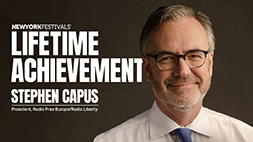 recognized alongside this esteemed community of storytellers. This honor is not mine alone, but a testament to the journalists I’ve worked with throughout my career – especially my RFE/RL colleagues who are committed to showing the world what is happening inside places like Ukraine and Iran. Their passion for excellence and dedication to the truth inspires me each day. My deepest gratitude to my family, whose support has made all of this possible.”
New York Festivals says, “Under Capus’s leadership, Radio Free Europe/Radio Liberty continues its mission to promote democratic values by delivering accurate, uncensored news and fostering open debate in countries where free press is threatened and disinformation is pervasive. Reaching nearly 50 million people each week, RFE/RL fills a critical gap in regions where independent journalism is restricted, banned, or still emerging.” Radio Free Europe/Radio Liberty’s programs have earned multiple awards from New York Festivals TV & Film and Radio Grand Juries. Most recently are 2025 Gold Tower for Human Rights Documentary “How Russian Forces Hunted Down A Ukrainian Shopkeeper In Bucha Bloodbath” (RFE/RL’s Ukrainian Service); 2025 Gold Tower for Sports Podcast “Gordafarid” (RFE/RL’s Persian-language service Radio Farda); 2024 Bronze Tower for Social Justice Podcast “Vida” (RFE/RL’s Persian-language service Farda); and 2024 Gold Tower for Human Rights Documentary for “Silent Deportation” (RFE/RL).
 Right,’ and ‘3 Martini Lunch.’” Radio America president and CEO Mike Paradiso states, “Helios Media is the natural progression of what Radio America has been building for decades – trusted content, powerful reach, and authentic voices that resonate with millions of Americans. With Helios Media, we’re giving creators the tools, the platform, and the audience to stand out in the competitive landscape of podcasting and digital media.” Radio America adds, “While Radio America continues its leadership in radio syndication – home to popular shows like ‘The Dana Show’ with Dana Loesch and ‘The Chad Benson Show’ – Helios Media serves as a distinct brand, purpose-built for podcast development, distribution, marketing and sales, amplifying news, culture, and entertainment stories through voices that challenge the mainstream and speak with conviction.”
  pretends it has the power to control news coverage. In reality, the FCC has vanishingly little power over national news networks. It licenses local broadcast stations, not networks, and no licenses are up for renewal until 2028. Early renewal attempts are exceedingly rare, and the process is so demanding that any effort would almost certainly fail, especially given the well-documented First Amendment violations underlying these moves. These threats are grounded in neither reality nor law and would not survive judicial scrutiny, just as other recent attempts by this Administration to push beyond constitutional limits have repeatedly failed in court.
 was hosted by comedian Ego Nwodim and streamed live exclusively on VEEPS. The event also broadcasted on select iHeartMedia radio stations at 11:00 pm local time and was available live on the iHeartRadio app. Among the numerous awards bestowed based on category, Jonathan Goldstein presented the Audible Audio Pioneer Icon Award to “Fresh Air” host Terry Gross, who accepted her award via video message. She recounted her beginnings as a volunteer at her college radio station and gaining her skills by “broadcasting in front of nearly no audience.”
 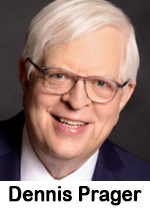 in Los Angeles Superior Court, he says he “still had some feeling and ability to move his toes” but was “otherwise unable to move his limbs and/or breathe on his own” when he was admitted to Cedars-Sinai. Prager accuses the staff at Cedar Sinai of failing to routinely turn him over and as a result he developed stage four pressure ulcers. The suit charges that the other two facilities “failed to take steps to adequately treat the pressure wounds. He claims his wife Susan begged Rancho Los Amigos staff to perform ostomy surgery so that Prager would not be in constant danger of sepsis, but Rancho Los Amigos refused.” The suit adds, “Thus, Prager did not heal, and he continued to be exposed on a daily basis to fecal bacteria pouring into his very deep open wounds.” The suit says his medical costs have exceeded $5 million over the last 13 months, a bill that “continues to grow at a staggering pace with each and every day.”
 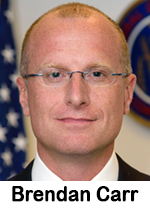 license renewals come up. The law is clear. Broadcasters must operate in the public interest, and they will lose their licenses if they do not. And frankly, changing course is in their own business interests since trust in legacy media has now fallen to an all time low of just 9% and are ratings disasters. The American people have subsidized broadcasters to the tune of billions of dollars by providing free access to the nation’s airwaves. It is very important to bring trust back into media, which has earned itself the label of fake news. When a political candidate is able to win a landslide election victory after in the face of hoaxes and distortions, there is something very wrong. It means the public has lost faith and confidence in the media. And we can’t allow that to happen. Time for change!” Carr included a Truth Social post from President Donald Trump in which he complains about papers such as The New York Times and The Wall Street Journal reporting on a strike against the U.S. base in Saudi Arabia that hit five refueling tanker planes. Trump said the reporting was intentionally wrong.
  nationally syndicated radio show, “FOX Across America,” and his FOX News Channel show, “FOX News Saturday Night.” The theme for this 10th Event & Dinner at Mohegan Pennsylvania on May 5 is “250 Years of American Liberty!” Bold Gold president Vince Benedetto says, “This being our 10th event and coinciding with
 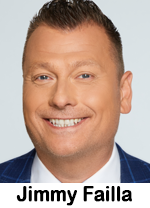 America’s 250th Birthday, we are doing everything bigger this year. In addition to celebrating 250 years of America, we’ll be celebrating 250 years of freedom of speech… and there is no greater daily example of that freedom that radio broadcasters. Radio, especially talk radio, remains America’s modern town hall. Our efforts at this event will help the next generation of radio broadcasters.” The Bold Gold Foundation will also be honoring Northeast Pennsylvania business leader and philanthropist Robert Tamburro with The Atlas Award for Citizenship. Bold gold says the Atlas Award is bestowed on individuals who, through their hard work and bold actions, show what is possible to achieve in a free society, and who exhibit extraordinary dedication to the highest ideals of character, community service, entrepreneurialism, patriotism, leadership, and virtue.
 syndication via Talk Media Network. The program will be fed live weekdays from 5:00 pm to 6:00 pm ET. Hooser says his program is a “one-hour conservative talk program that focuses on recapping the day’s events and brings a fresh perspective on the big stories of the day with fun conversation and great daily guests.” The program is based at Steckline Communications’ KQAM, Wichita where he serves as operations manager.
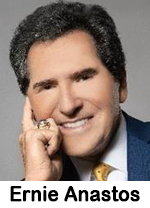 died at the age of 82. Anastos worked at the local New York affiliates of ABC, CBS and FOX. In recent years, he hosted a feature on WABC Radio titled, “Positively Ernie.” Red Apple Media Group CEO John Catsimatidis commented on Anastos’ passing saying, “Ernie was a friend for 50 years. He was always there for every charity and worked tirelessly to help people — especially New Yorkers.”
 Carrier Bureau, helping implement the Act. In the webinar titled “30th Anniversary of the 96 Act: What Did We Learn?” panelists will explore how lessons from the past 30 years can drive innovation and competition for consumers today. Topics will include artificial intelligence, media, competition, convergence, access, and cybersecurity. The three separate panels will include Panel 1 looking at “The Legislative Process That Led to the Act; Panel 2 will address “FCC Implementation of the Act”; and Panel 3 will focus on “Today’s Challenges.” Interested parties can join online via the
  -AM/FM and country KPLZ-FM. At the same time, the company announces that Jeff Connell is the new director of operations & brand management. Adams most recently served with Stephens Media Group in Spokane. Connell rises from his role as regional PD for KPLZ and KTHI-FM, Boise. In his new role, Connell will give up his programming role at KTHI.
 presented at ACL Live at the Moody Theatre at 8:00 pm ET. Actress, comedian and host of the “Thanks Dad” podcast, Ego Nwodim, will emcee this year’s iHeartPodcast Awards, actor and comedian Will Ferrell will open the show and Holly Frey, host of “Stuff You Missed in History Class,” will be the winners correspondent. The full list of the 2026 iHeartPodcast Awards categories and nominees can be found
  pharmaceutical brand’s original buy targeting adults 18-54, 100% of the budget was allocated to traditional television, with 87% to broadcast and 13% to cable. This achieved a reach of 39%. By shifting only 5% of the total spend away from the usual go-to television outlets, and into podcasts, reach increased significantly. Reach among those ages 18-54 went from 39% in the old campaign to 55% in the new campaign, a lift of 41%. Note that this is shifting dollars, not adding dollars. The brand reached 26 million additional people without increasing the advertising budget.
 Small businesses often underestimate their greatest competitive edge. It’s not price. It’s not selection.
 and 25–54 with double-digit shares of 13.9 and 13.1, respectively. The show is hosted by DJ Envy, Jess Hilarious, and Charlamagne Tha God and plays an important role in urban youth culture. iHeartMedia EVP of programming Thea Mitchem states, “The Breakfast Club continues to set the standard for what a truly multiplatform powerhouse looks like. These record‑setting ratings are a direct reflection of the team’s talent, consistency, and cultural impact. DJ Envy, Jess Hilarious, Charlamagne Tha God, and our exceptional production and digital teams deliver a show that resonates deeply with audiences across every platform. We’re incredibly proud of this achievement and grateful to the listeners of New York who make ‘The Breakfast Club’ a defining force in media.”
 $600 million of debt, “substantially deleveraging its balance sheet and enhancing its ability to execute on strategic priorities.” The company says it will continue operating in the ordinary course throughout the process, with no impact to employees, partners, or listeners.
 macroeconomic and industry-wide pressures we have faced have remained unrelenting. Against that backdrop, it became clear that Cumulus’s remaining debt burden limited our ability to fully realize the company’s potential, and this agreement represents a major step forward. The prepackaged process is intended to address the company’s debt efficiently with no disruption to our operations, our people, and our strategies. On emergence, a stronger financial foundation will better position Cumulus to continue investing in premium content, enriched audience experiences, advertiser performance enhancements, and the ongoing growth of our digital marketing offerings.” Cumulus has filed a proposed Plan of Reorganization that incorporates the terms of the RSA and is subject to approval by the Court. The requisite majority of debtholders committed to vote in favor of the Plan, which calls for the cancellation of 100% of the company’s existing funded indebtedness in exchange for 100% of the company’s reorganized equity and $50 million of new convertible notes, as well as the amendment and restatement of the company’s asset-based revolving credit facility to provide continued liquidity. Cumulus expects that the Court will hold a hearing to consider the approval of the Plan within 60 days of the filing date and that the company will emerge from bankruptcy following receipt of required regulatory approvals from the Federal Communications Commission.
 Talk radio has a long incredibly successful run of shows about sex.
 among adults has surged from just 6% of audio listening in 2015 to 23% in 2025. The two factors responsible for his are new people listening to podcasts (reach) and existing podcast consumers listening more (frequency). Das says that additional listening is replacing other behaviors. “Nearly four in 10 podcast listeners say the time they spend with podcasts is replacing time spent scrolling social media. Another 34% say it’s replacing time spent listening to streaming music.” Das cites data indicating that “U.S. adults spend an average of 103 minutes per day listening to podcasts, outpacing TikTok (77 minutes), Facebook (69 minutes), and Instagram (65 minutes); and “Podcast listening surpassed streaming music in 2023, and now commands an 11 point share advantage in daily digital ad-supported audio listening.”
 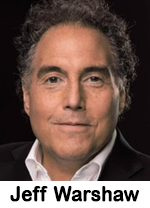 Management’s Michael Del Nin in 2022 and began working together “to try to acquiring Cox Radio, with Del Nin agreeing that Warshaw would manage the business as CEO upon successful acquisition.” While both parties were doing due diligence on the CMG deal, Warshaw learned that an Audacy majority stake holder was willing to sell its stake in the company. Warshaw says he steered SFM and Del Nin to the deal that made SFM a majority stake holder of the new Audacy in early 2024. Warshaw alleges he was promised he’d be the next CEO of Audacy or that he would get 5% of SFM’s profits from the Audacy acquisition. Later, SFM filed a motion to strike arguing that talks between Del Nin and Warshaw did not rise to the level of an employment offer. In his recent filing with the court, Warshaw says SFM reads “the Complaint in the light least favorable to Plaintiff. And they introduce new facts and make factual arguments that must be left for resolution by a jury at trial. Even so, based on the Complaint’s detailed allegations, Defendants’ arguments fall apart. Defendants ask the Court to believe that Jeffrey Warshaw, a veteran executive and dealmaker in radio, attempted to ‘cozy up’ to Defendants, newcomers to radio. But why did they seek an introduction to Warshaw in the first place? Why did they need Warshaw to source the Audacy transaction, and quickly ask him to introduce them to Audacy’s controlling debtholder? Why did Michael Del Nin call Warshaw 107 times between October 2023 and October 2024? On breach of contract, Defendants argue that the Complaint does not plead definite and certain terms of the contract between Warshaw and SFM. That ignores the definiteness of the contract terms alleged, as well as controlling precedent holding that an oral agreement is enforceable so long as missing terms can be ascertained by fair implication or industry custom. Defendants also downplay the value of Warshaw’s sourcing of the Audacy deal and his introduction of Defendants to the firm holding a controlling interest in Audacy debt.”
 field with global technology platforms.” He underscored broadcasters’ unique and essential role in public safety, civic engagement and strengthening local democracy. Additionally, broadcasters heard from key policymakers shaping broadcast policy, including Sen. Ed Markey (D-MA), who spoke about the enduring value of broadcast radio and his leadership on the bipartisan effort to pass the AM Radio for Every Vehicle Act… and U.S. Rep. Richard Hudson (R-NC), chairman of the House Energy and Commerce Subcommittee on Communications and Technology, who spoke about the need for broadcast ownership rules to reflect today’s landscape and the importance of keeping AM radio in cars.
 Station owner John Catsimatidis says, “Big name personalities define WABC Radio. Sean is a powerful addition to our Sunday lineup and another example of WABC’s unmatched ability to attract major talent and deliver must-hear talk. The show is going to be fast, fearless, and honest, with smart conversation, sharp opinion, and honest discussion about the stories driving the country.” Spicer comments, “WABC Radio doesn’t whisper, it leads! It is one of the most iconic and influential radio stations in the U.S. WABC Radio listeners expect truth, energy, and authenticity, and that’s exactly what I’m going to give them. I couldn’t be more excited to join the incredible 77WABC lineup.”