The Soundbite Trap: How Editing in Radio and Podcasting Creates Legal Risk
By Matthew B. Harrison
TALKERS, VP/Associate Publisher
Harrison Media Law, Senior Partner
Goodphone Communications, Executive Producer
 In radio and podcasting, editing isn’t just technical – it shapes narratives and influences audiences. Whether trimming dead air, tightening a guest’s comment, or pulling a clip for social media, every cut leaves an impression.
But here’s the legal reality: editing also creates risk.
For FCC-regulated broadcasters, that risk isn’t about content violations. The FCC polices indecency, licensing, and political fairness – not whether your edit changes a guest’s meaning.
For podcasters and online creators, the misconception is even riskier. Just because you’re not on terrestrial radio doesn’t mean you’re free from scrutiny. Defamation, false light, and misrepresentation laws apply to everyone — whether you broadcast on a 50,000-watt signal or a free podcast platform.
At the end of the day, it’s not the FCC that will hold you accountable for your edits. It’s a judge.
1. Alex Jones and the $1 Billion Lesson
Alex Jones became infamous for promoting conspiracy theories on Infowars, especially his repeated claim that the Sandy Hook shooting was a hoax – supported by selectively aired clips and distorted facts.
The result? Nearly $1 billion in defamation verdicts after lawsuits from victims’ families.
Takeaway: You can’t hide behind “just asking questions” or “it was my guest’s opinion.” If your platform publishes it – over the airwaves or online – you’re legally responsible for the content, including how it’s edited or framed.
2. Katie Couric and the Gun Rights Group Edit
In “Under the Gun,” filmmakers inserted an eight-second pause after Katie Couric asked a tough question, making it seem like a gun rights group was stumped. In reality, they had answered immediately.
The group sued for defamation. The case was dismissed, but reputations took a hit.
Takeaway: Even subtle edits – like manufactured pauses – can distort meaning and expose creators to risk.
3. FOX News and the Dominion Settlement
FOX News paid $787 million to Dominion Voting Systems after airing content suggesting election fraud – often based on selectively edited interviews and unsupported claims.
Though FOX is (among other things) a cable network, the impact shook the media world. Broadcasters reassessed risks, host contracts, and editorial practices.
Takeaway: Major networks aren’t the only ones at risk. Radio hosts and podcasters who echo misleading narratives may face similar legal consequences.
4. The Serial Podcast and the Power of Editing
“Serial” captivated millions by exploring Adnan Syed’s murder conviction. While no lawsuit followed, critics argued the producers presented facts selectively to build a certain narrative.
Takeaway: Even without a lawsuit, editing shapes public perception. Misleading edits may not land you in court but can damage trust and invite scrutiny.
Whether you’re behind a radio microphone or a podcast mic, your editing decisions carry weight – and legal consequence.
The FCC might care if you drop an indecent word on air, but they won’t be the ones suing you when a guest claims you twisted their words. That’s civil law, where defamation, false light, and misrepresentation have no broadcast exemption.
There’s one set of rules for editing that every content creator lives by – and they’re written in the civil courts, not the FCC code.
Edit with care.
Matthew B. Harrison is a media and intellectual property attorney who advises radio hosts, content creators, and creative entrepreneurs. He has written extensively on fair use, AI law, and the future of digital rights. Reach him at Matthew@HarrisonMediaLaw.com or read more at TALKERS.com.

 Let’s look into the crystal ball. Humor me if you will.
 Let’s discuss how CBS’s $16 million settlement became a warning shot for every talk host, editor, and content creator with a mic.
 Music on the weekend provides multiple positive strategic weapons for talk stations. From launch, “New Jersey 101.5” (1,000,000+ cumer); WTKS-FM “Real Radio,” Orlando; WABC, New York; WPHT, Philadelphia; and other major market winners air music all weekend or on dayparted shows.

 Are archived shows – whole hours – your station’s only on-demand offering? It’s an easy checkbox: post the aircheck, call it a podcast.
 If you saved back issues from when TALKERS was a print tabloid, dig-down about 20 years into the stack. A couple times a year beginning then, I was reporting from conferences then called The Podcast and New Media Expo, which later evolved into NMX and BlogWorld and other incarnations.
 The drive to stream video of radio shows has always been risky. Remember your shock when you first saw one of your radio heroes? Video streaming can present a constant disconnect between the show in the listener’s head and the show on the stream. Many stations make the disconnect worse by streaming terrible video images. Combine the trauma of how a host really looks with a dreary TV show and the package cannot benefit the relationship between station and listener/viewer.
 right, two shows… one on the radio, one on the stream. Seamless and fun.
 With so many of us taking vacation time soon, guest hosts are often local somebodies who are not career broadcasters and don’t share our second-nature performance routines. For their benefit, these tips, based on my experience on both sides of the mic:
 At first, I thought it was a joke. When I realized there were serious people having serious meetings about the joke, it became both horrific and symptomatic
 In the golden age of broadcasting, the rules were clear. If you edited the message, you owned the consequences. That was the tradeoff for editorial control. But today’s digital platforms – YouTube, X, TikTok, Instagram – have rewritten that deal. Broadcasters and those who operate within the FCC regulatory framework are paying the price.
 This coming Sunday, June 15, is Father’s Day. For that day – and the Friday before (hint-hint) – you might have already readied Harry Chapin’s “
 When Georgia-based nationally syndicated radio personality, and Second Amendment advocate Mark Walters (longtime host of “Armed American Radio”) learned that ChatGPT had falsely claimed he was involved in a criminal embezzlement scheme, he did what few in the media world have dared to do. Walters stood up when others were silent, and took on an incredibly powerful tech company, one of the biggest in the world, in a court of law.
 “Fewer than half of Americans plan to travel this Summer,” according to a
  Dozens of brand-new audio hardware and software companies have been launched during the past 20 years. These start-ups are usually funded by venture capital money. VC money is not invested to return a profit, it’s poured in to – pour it in. Their money is “different” than the cashflow that fuels your business. Start-up money buys time to profit.
 In a ruling that should catch the attention of every talk host and media creator dabbling in AI, a Georgia court has dismissed “Armed American Radio” syndicated host Mark Walters’ defamation lawsuit against OpenAI. The case revolved around a disturbing but increasingly common glitch: a chatbot “hallucinating” canonically false but believable information.
 TALKERS publisher Michael Harrison introduced the term in the 1990s, inviting us to think-beyond the real-time audio we were sending up those towers. What he described seemed conceptual, even futuristic, back then, when we were still logging-onto AOL via dial-up (screech).
 Right now, dozens of well-suited, over-priced, unpleasant lawyers are fighting in Hollywood over the title credit their client should receive on a movie, TV show, or book cover. Placement within the credit roll at the end of a show is a battleground of egos and legalities. Part of the process of securing proper credit is governed by multiple union rules negotiated by multiple unions and corporate dictates of corporate masters. (You don’t get to be CEO of Paramount by being a nice guy.)
 Music radio’s competitors were vinyl, then tape, then CDs – before smartphone streaming and satellite radio offered more portability and variety. And before consolidation, broadcasters were under less of the revenue pressure that now commercializes many stations beyond listeners’ tolerance.
  “It won’t work on FM.” Country. Country was predicted to be a failing format for the FM band. At the dawn of FM proliferation in the 1970s, the future of the band was viewed with fear and skepticism. Why wouldn’t country music work on the FM band? The conventional chatter said that “country needs to be on AM because truckers drive long distances and AM signals cover long distances. FM does not.”
 When a blogger found “no biography, or further information about the woman who is supposedly presenting this show,” it forced Australian Radio Network to
  These books have helped me tell stories, prioritize programming initiatives and manage career strategies. If interested in a book the link connects to its page on Amazon.
 These conventions used to be about making-the-most-of those towers behind radio stations that played in several rooms at home and occupied two knobs and six buttons in the dashboard. Back to the future…
 Serious business coaches reveal that a common trait of successful people is their ability to immediately forget their failures and to move on. Next idea. Next project. Surrounded by seas of committees, forms, rules and mediocrity, effective leaders know that just trying something, regardless of the outcome, is the WIN.
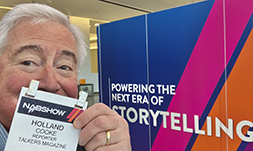
  Hello from Las Vegas, ever-changing yet timeless. Here this week the NAB Show is “Powering the Next Era of Storytelling.” And it’s about time. While there is now a filibuster-proof U.S. Senate majority to require that cars include AM receivers, some AM stations are being shut off. Over the weekend millions took to the streets and this morning Wall Street braced for more. So, the vibe here is positively rejuvenating.
 Corporate cost cuts continue. In
  Thank you, TALKERS for placing me on two panels at the IBSNYC conference. All student conferences have one underlying goal: Attendees want to know how to land a starter job in media. Here’s the information I shared with the eager crowd.