By Matthew B. Harrison
TALKERS, VP/Associate Publisher
Harrison Legal Group, Senior Partner
Goodphone Communications, Executive Producer
 When Georgia-based nationally syndicated radio personality, and Second Amendment advocate Mark Walters (longtime host of “Armed American Radio”) learned that ChatGPT had falsely claimed he was involved in a criminal embezzlement scheme, he did what few in the media world have dared to do. Walters stood up when others were silent, and took on an incredibly powerful tech company, one of the biggest in the world, in a court of law.
Taking the Fight to Big Tech
Walters, by filing suit against OpenAI, the creator of ChatGPT, become the first person in the United States to test the boundaries of defamation law in the age of generative artificial intelligence.
His case was not simply about clearing his name. It was about drawing a line. Can artificial intelligence generate and distribute false and damaging information about a real person without any legal accountability?
While the court ultimately ruled in OpenAI’s favor on specific legal procedure concerns, the impact of this case is far from finished. Walters’ lawsuit broke new ground in several important ways:
— It was the first known defamation lawsuit filed against an AI developer based on content generated by an AI system.
— It brought into the open critical questions about responsibility, accuracy, and liability when AI systems are used to produce statements that sound human but carry no editorial oversight.
— It continued to add fuel to the conversation of the effectiveness of “use at your own risk” disclaimers when there is real world reputational damage hanging in the balance.
Implications for the Radio and Podcasting Community
For those spoken-word creators, regardless of platform on terrestrial, satellite, or the open internet, this case is a wake-up call, your canary in a coal mine. Many shows rely on AI tools for research, summaries, voice generation, or even show scripts. But what happens when those tools get it wrong? (Other than being embarrassed, and in some cases fined or terminated) And worse, what happens when those errors affect real people?
The legal system, as has been often written about, is still playing catch-up. Although the court ruled that the fabricated ChatGPT statement lacked the necessary elements of defamation under Georgia law, including provable harm and demonstrable fault, the decision highlighted how unprepared current frameworks are for this fast-moving, voice-driven digital landscape.
Where the Industry Goes from Here
Walters’ experience points to the urgent need for new protection and clearer guidelines:
— Creators deserve assurance that the tools they use are built with accountability in mind. This would extend to copyright infringement and to defamation.
— Developers must be more transparent about how their systems operate and the risks they create. This would identify bias and attempt to counteract it.
— Policymakers need to bring clarity to who bears responsibility when software, not a person, becomes the speaker.
A Case That Signals a Larger Reckoning
Mark Walters may not have won this round in court, but his decision to take on a tech giant helped illuminate how quickly generative AI can create legal, ethical, and reputational risks for anyone with a public presence. For those of us working in media, especially in formats built on trust, voice, and credibility, his case should not be ignored.
“This wasn’t about money. This was about the truth,” Walters tells TALKERS. “If we don’t draw a line now, there may not be one left to draw.”
To listen to a longform interview with Mark Walters conducted by TALKERS publisher Michael Harrison, please click here
Media attorney, Matthew B. Harrison is VP/associate publisher at TALKERS; Senior Partner at Harrison Legal Group; and Executive Producer at Goodphone Communications. He is available for private consultation and media industry contract representation. He can be reached by phone at 724-484-3529 or email at Matthew@HarrisonLegalGroup.com. He teaches “Legal Issues in Digital Media” and serves as a regular contributor to industry discussions on fair use, AI, and free expression.




 rights, including the Second Amendment, educate and inform Americans about firearms rights and legislation, and raise awareness of the issues impacting gun owners.” Further details regarding AAR content distribution and original programming will be announced as projects develop. Walters says, “I’m honored and thrilled to partner Armed American Radio and CCW Broadcast Media, LLC together with C3 Entertainment, Inc. These are historic times for our constitutional rights. We are excited to unite the important current events of the day together with history in an enlightening, entertaining, and educational format that will remind all Americans not only WHY we are the greatest nation the world has ever seen but HOW we got here and WHAT must be done going forward to preserve our uniquely American way of life!”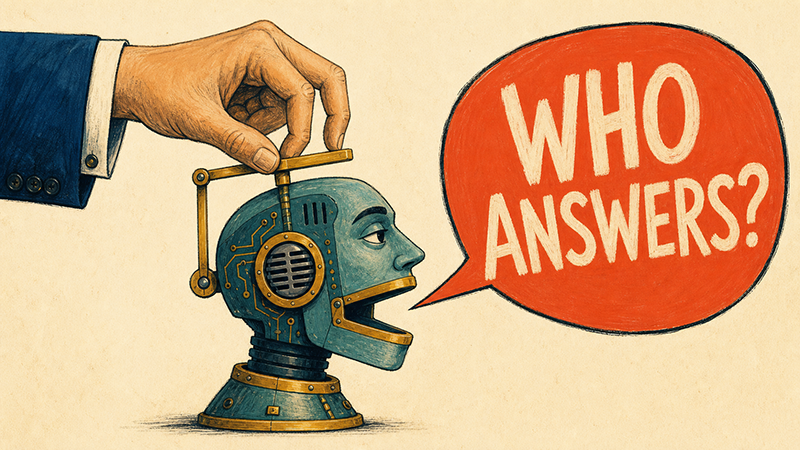
 New laws may hold AI companies responsible, but regulating machine-generated speech presents risks of its own.
 stations in February and March. His “Armed American Radio” and “Daily Defense Hour” shows are now heard on KVOC, Casper, Wyoming. WOBX, Wanchese, North Carolina adds the “Daily Defense Hour.” “Armed American Radio” also joins WNRJ, Huntington, West Virginia and WXIC, Waverly, Ohio. Additionally, WKDP, Corbin, Kentucky bumps the “Daily Defense Hour” to live, daily from 5:00 pm to 6:00 pm.
 and the “AAR Daily Defense Hour” join the programming at Omni Broacasting’s WTKE in the Ft. Walton Beach-Destin, Florida market. Additionally, the “Armed American Radio” show is being distributed by CRN Talk to cable systems operated by Cox Communications, Optimum TV, and Xfinity Stream.
 The weekend program – hosted by Mark Walters – “Armed American Radio” is added to the program lineup at four stations including WZGM-AM, Asheville, North Carolina and WXZQ-FM, Columbus, Ohio. The “AAR Daily Defense Hour” adds three new affiliates including WNWS-FM, Jackson, Tennessee.
 In a ruling that should catch the attention of every talk host and media creator dabbling in AI, a Georgia court has dismissed “Armed American Radio” syndicated host Mark Walters’ defamation lawsuit against OpenAI. The case revolved around a disturbing but increasingly common glitch: a chatbot “hallucinating” canonically false but believable information.
 stations including KOMY-AM, Monterey-Salinas, California; WSCW-AM, Charleston, West Virginia; and more.
  which he oversees 12 stations across Kansas and Oklahoma and hosts a popular, award-winning show, “The Voice of Reason” on “Big Talker” KQAM. Over the years, this dynamic millennial’s reputation as a talent-on-the-ascent has grown significantly. Heavy Hundred syndicated star Todd Starnes knows that and turns to Hooser as a regular guest-host on his show, receiving positive feedback. He also regularly serves as a guest-host on “Armed American Radio with Mark Walters.” Now Hooser’s “The Voice of Reason” has been launched into national syndication as a two-hour
  weekend show airing live on Saturdays 5:00 – 7:00 pm ET and offered by his own independent Hooser Media Network (distributed via satellite by Salem Radio Network). Hooser tells TALKERS, “There is a great need in the industry for live, fresh, weekend conservative talk programming. Now stations won’t have to wait for Monday to recap breaking stories over the weekend. They can stay informed and up to date with a show discussing the big weekend events, while recapping the conversations of the previous week.” “The Voice of Reason” can be aired live or downloaded for delayed broadcast on Saturday nights or anytime Sunday. For information, call Hooser Media Network at 316-553-0992 or
  stating the Walters was accused of embezzling funds from the Second Amendment Foundation defamed him. No such accusation ever actually took place. In its Motion to Dismiss, Open AI argued several points, including that Georgia is not the proper jurisdiction, but it summarized its argument that Walters’ claims didn’t meet the burden of defamation when it said, “Even more fundamentally, Riehl’s use of ChatGPT did not cause a ‘publication’ of the outputs. OpenAI’s Terms of Use make clear that ChatGPT is a tool that assists the user in the writing or creation of draft content and that the user owns the content they generate with ChatGPT. Riehl agreed to abide by these Terms of Use, including the requirement that users ‘verify’ and ‘take ultimate responsibility for the content being published.’ As a matter of law, this creation of draft content for the user’s internal benefit is not ‘publication.’”
  Amendment Foundation defamed him. No such accusation ever actually took place. In its Motion to Dismiss, Open AI argues several points, including that Georgia is not the proper jurisdiction, but it summarizes its argument that Walters’ claims don’t meet the burden of defamation when it says, “Even more fundamentally, Riehl’s use of ChatGPT did not cause a ‘publication’ of the outputs. OpenAI’s Terms of Use make clear that ChatGPT is a tool that assists the user in the writing or creation of draft content and that the user owns the content they generate with ChatGPT. Riehl agreed to abide by these Terms of Use, including the requirement that users ‘verify’ and ‘take ultimate responsibility for the content being published.’ As a matter of law, this creation of
  Second Amendment Foundation. The complaint states that journalist Fred Riehl was researching the case of The Second Amendment Foundation v. Robert Ferguson and asked ChatGPT to provide a summary of that complaint and received one that stated the suit’s plaintiff is Second Amendment Foundation founder Alan Gottlieb who accuses Walters as treasurer and chief financial officer of embezzling funds. Walters says, and Gottlieb confirms, that he didn’t serve in either position and didn’t steal anything. In the AI world, false text from services like ChatGPT are called “hallucinations.” As with any defamation case, Walters will have to prove he’s suffered damages, but this case will be interesting to watch as it appears to be the first such legal case involving the work of AI.