



Industry Views

The Advertiser Gave It To Me. Isn’t That Enough?
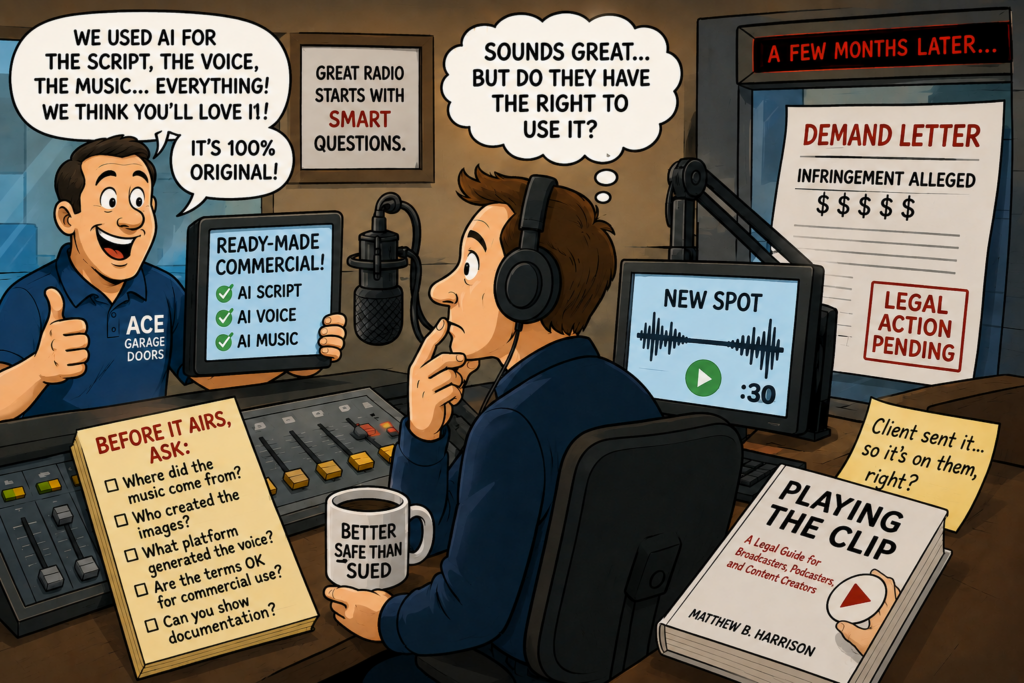
Harrison's imagination of reality

By Matthew B. Harrison
TALKERS, VP/Associate Publisher
Harrison Media Law, Senior Partner
Goodphone Communications, Executive Producer

imgA local advertiser sends over a ready-made commercial. The music is catchy. The script is polished. The production value is surprisingly good for a company that spends most of its day installing garage doors.

The salesperson approves it. Traffic schedules it. The spot airs.

A few months later, somebody else’s lawyer hears it too.

Many media professionals assume that when an advertiser supplies content, the advertiser has already secured whatever permissions are necessary to use it. Sometimes that’s true. Sometimes it isn’t.

If a commercial contains copyrighted music, photographs, video, artwork, or other protected material, the fact that it came from a client does not automatically end the discussion. The advertiser may have obtained the rights. The advertiser may have assumed someone else obtained the rights. The advertiser may never have asked.

Artificial intelligence is creating new versions of the same problem.

Recently, I was asked about a commercial generated almost entirely through AI. The advertiser used one platform to create the script and another to generate the voice. Everything sounded original. No famous song. No movie clip. No obvious red flags.

Yet one question remained:

How do you know the advertiser had the right to use it?

That question can lead in several directions. Did the AI platform permit commercial use? Was the voice modeled after a real person? Does it sound enough like a celebrity to create endorsement concerns? Can the advertiser demonstrate where the content came from and what rights accompany it?

Fortunately, the solution is usually simple. Ask the advertiser.

Most legitimate advertisers are happy to explain how the content was created and what rights they possess. The conversation often takes only a few minutes.

Broadcasters, podcasters, streamers, and digital creators all face the same reality. Before a commercial airs, someone should know where the content came from and whether the necessary rights exist.

The technology may change. The question remains remarkably durable: How do you know you had the right to use this?

Matthew B. Harrison is a media and intellectual property attorney who advises radio hosts, content creators, and creative entrepreneurs. He has written extensively on fair use, AI law, and the future of digital rights. Reach him at Matthew@HarrisonMediaLaw.com or read more at https://harrisonlegalgroup.com.

Industry Views

Monday Memo: MAKE MONEY on YouTube

By Holland Cooke
Consultant

imSell a local advertiser a promotion – a contest which awards a major prize from the advertiser’s inventory – to the winner who creates the best commercial for the advertiser.


Simplify the entry process by simply making “Send us your YouTube link” the means-of-entry. Then, you can embed finalists’ YouTube players on a-page-of-entries, (sponsored by the advertiser). And you can use the YouTube hit count to determine the winner. Sure, contestants will hype-the-clicks. The bigger the numbers, the better.

im

The Free Prize Inside: You don’t just expose advertiser and contest to YOUR cume. You’re showing it to YouTube’s cume! So, pack those keywords.

And/or: Invite listeners to do a commercial for the station!

Holland Cooke (HollandCooke.com) is a consultant working at the intersection of broadcasting and the Internet. He is the author of “Close Like Crazy: Local Direct Leads, Pitches & Specs That Earned the Benjamins” and “Confidential: Negotiation Checklist for Weekend Talk Radio.” Follow HC on Twitter @HollandCooke and connect on LinkedIn.

Industry Views

When Crisis Strikes

By Steve Lapa
Lapcom Communications Corp
President

Can you define “crisis?”

Let’s start with “highly challenging,” move to “difficult,” layer in “nonstop pressure” and quickly fast forward to “intense circumstances.”

This is just from the outside looking in. From the inside looking out the crisis owns the clock and the emotions of its victims. Nothing else matters until the crisis is resolved.

Chances are your sales meetings have never addressed how to work with a local advertiser who is experiencing a marketing crisis. And that is because most managers have minimal experience working through a local advertiser’s marketing crisis.

Large-scale businesses typically coordinate consulting firms, experts, and major ad agencies. Think Tylenol, Chipotle, even VW. But chances are your local direct advertiser may not have the time to coordinate a full-blown crisis management team and responding to their call is now in your in box.

Recently, I found myself knee-deep in executing a plan to help manage a large-scale crisis. The experience was an eye-opener. Hopefully, you can learn from what is next. Here are suggested steps:

— Communication is critical. Listen carefully, be empathetic, clarify all goals that may be hazy and finally get a clear understanding of any timelines.

— Collaborate. Be clear with everyone on your team about the situation. Review internal protocols for copy, production, available inventory, and pricing.

— Long-Term vs. Short-Term. When an advertiser needs to get the word out quickly and efficiently, the temptation to raise rates or forced packaging is real. It is guaranteed that your advertiser will remember the team that grabbed an oar to help guide them to a safe harbor as opposed to the team that grabbed a hammer to nail the budget to the wall.

— Coordinate. Stay in contact with your advertiser. Remember, the crisis owns the clock and your client is focused on solving the crisis, so common sense counts.

— When in doubt take the simple route. If copy is a problem, suggest options. If credit is a problem, suggest a plan. If a talent balks, come up with a back-up. In a crisis, hurdles become mountains and climbing mountains takes months of training. Keep the solution path simple and easy to navigate.

— This too shall pass. Your goal in any local marketing crisis should be to become an ally, a trusted, dependable resource so that when the crisis passes your relationship is cemented.

Take a minute to review and expand on those six take-aways. Selling in a crisis environment is rarely a simple experience. Hopefully, you will be a little better prepared when a marketing crisis strikes.

Steve Lapa is the president of Lapcom Communications Corp. based in Palm Beach Gardens, FL. Lapcom is a media sales, marketing, and development consultancy. Contact Steve Lapa via email at: Steve@Lapcomventures.com

Sales

Pending Business: When the Crystal Ball Is Foggy

By Steve Lapa
Lapcom Communications Corp
President


PALM BEACH GARDENS, Fla. — Its seems the current economic cycle is being driven by a sweeping round of cutbacks and strategic business re-focus now moving into the mainstream.

From Disney and Meta (parent of Facebook) to Walmart, the pressure is on to deliver positive performance in a cloudy economy. In plain English, it’s time to cut costs and push suppliers to share the pain. Yet prices continue to go up. Maybe it’s the fault of COVID’s unpredictable economic impact or some international collusion, or better yet, just a plain old foggy crystal ball in the CEO’s office. My vote is all of the above. But what does any of this have to do with your day-to-day sales? The short answer is: Everything.

(more…)